Why This Decision Matters More Than It Seems
Packing a safety kit feels responsible — and it is. But the size and contents of that kit carry real consequences for how you travel. A poorly calibrated kit either leaves you scrambling for basics at a foreign pharmacy or buries you in supplies you'll never touch. Neither is ideal when you're already managing a new destination, a language barrier, and a packed itinerary.
This isn't just about weight. It's about decision-making under stress. When you're ill or injured abroad, a small, clearly organized kit you know well is far more useful than an overstuffed bag you have to excavate. First-time travelers especially benefit from thinking through this before they leave — not at the airport.
Your destination should anchor every decision here. Before you finalize anything, it's worth reading about how to pick the right destination for your first trip — because a city break in Europe and a hiking expedition in Central America require fundamentally different preparation.
The Case for Packing a Comprehensive Safety Kit
There are genuine situations where a fuller kit earns its weight. Remote hiking, cruises (where onboard medical care can be expensive), international road trips, and destinations with limited pharmacy infrastructure are all contexts where having more supplies on hand is a defensible choice.
Prepared for destinations with limited pharmacy access
Rural, remote, or developing-world destinations may not have reliable access to familiar medications. A fuller kit means you're not dependent on finding a pharmacy that stocks what you need.
Covers medical needs during long travel gaps
Long cruises, multi-day overland trips, or back-to-back flights can leave you without easy pharmacy access for days. Having supplies on hand prevents minor issues from escalating.
Reduces reliance on expensive onboard or resort medical services
Ship medical centers and hotel doctors can charge significantly for routine consultations and basic supplies. Bringing your own cuts this cost substantially.
Peace of mind for anxious first-time travelers
For travelers who find comfort in preparation, having a thorough kit reduces pre-trip anxiety and lets them focus on enjoying the experience rather than worrying about what-ifs.
For cruise travelers in particular, having your own supplies is especially practical — ship medical centers charge significantly for routine care. The cruise cabin packing guide covers this in more detail, including what cruise lines typically restrict.
The Case for Traveling Light on Safety Gear
For most first-time travelers visiting urban destinations, resort areas, or countries with well-developed pharmacy networks, a comprehensive kit is largely redundant. Pharmacies in major European, Asian, and Latin American cities are easy to find, often open late, and carry familiar products — sometimes at lower prices than back home.
Adds significant weight and bulk to your luggage
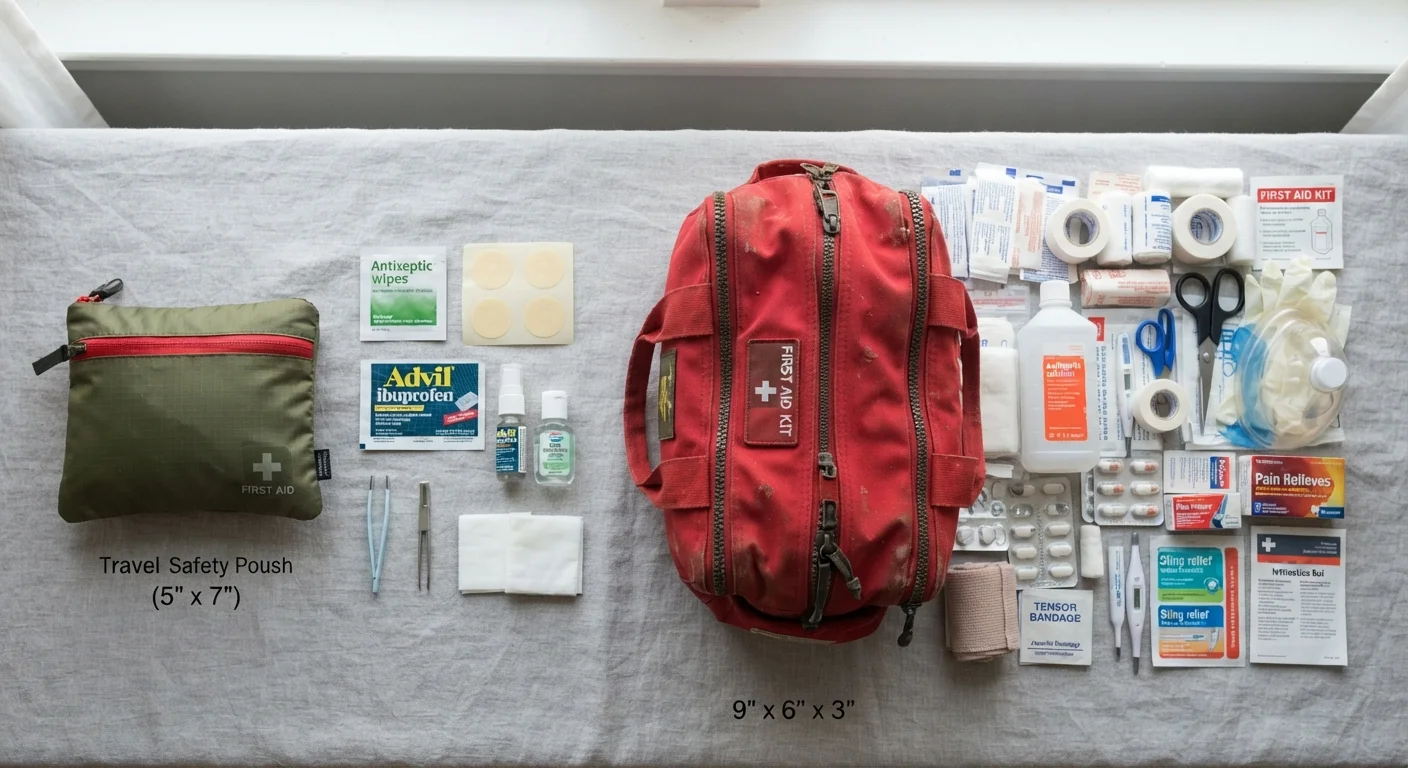
A full first-aid kit can easily weigh two to three pounds and take up meaningful space — a real cost if you're trying to travel with carry-on only or keep a bag manageable.
Many supplies are available abroad and go unused
Urban destinations in Europe, Asia, and Latin America have well-stocked pharmacies. Packing duplicates of what you can buy locally wastes space and money.
Can create TSA complications at security
Liquids over 3.4 oz, sharp instruments like scissors or lancets, and certain prescription medications require careful documentation and packaging to clear security without delays.
Overpacked kits are harder to use in an emergency
A disorganized, overstuffed kit takes longer to search under stress. A compact, clearly arranged kit is more practical when you actually need it.
Expiration and waste risk on short trips
Medications and supplies packed for a short trip often go unused and may expire before the next trip — a recurring cost with little return for light travelers.
Traveling light also reduces TSA friction. Liquids, sharp items like scissors, and certain medications all require careful handling. The carry-on vs. checked bag guide explains what typically triggers screening issues, which matters when you're packing any medical supplies in your carry-on.
~80%
Travelers who never use most kit items
Travel health professionals commonly observe that the majority of travelers on standard urban or resort trips use only pain relief and stomach remedies from their safety kits, if anything.
2–3 lbs
Typical weight of a comprehensive first-aid kit
A fully stocked over-the-counter first-aid kit can add two to three pounds to your luggage — a meaningful trade-off when most airlines cap carry-on weight allowances.
What Belongs in a Lean, Effective Travel Safety Kit
A sensible baseline kit for most trips fits in a small zip pouch and covers five categories: pain and fever relief, wound care (a few adhesive bandages and antiseptic wipes), stomach distress (antidiarrheal and antacid), any personal prescription medications in original labeled containers, and copies of key documents (insurance card, prescription details, emergency contacts).
That last category is arguably the most overlooked. A photo of your passport, travel insurance policy number, and your doctor's contact saved securely in cloud storage costs nothing and takes up no physical space — but it matters enormously if something goes wrong. For a fuller look at pre-trip health preparation, see health precautions every first-timer should take.
A Note on Medications and Border Rules
Certain medications that are legal in the US — including some common painkillers, sleep aids, and ADHD medications — are controlled or prohibited in other countries. Always carry prescriptions in their original labeled containers and verify the rules for your specific destination with the relevant embassy or consulate before you travel. Do not rely on this article or any general source as a definitive guide to another country's medication laws.
Beyond supplies, situational awareness is part of your safety kit too. The broader guide on personal safety on the road covers non-medical precautions that are just as important as what's in your bag.