How DCC Gets Presented to Travelers
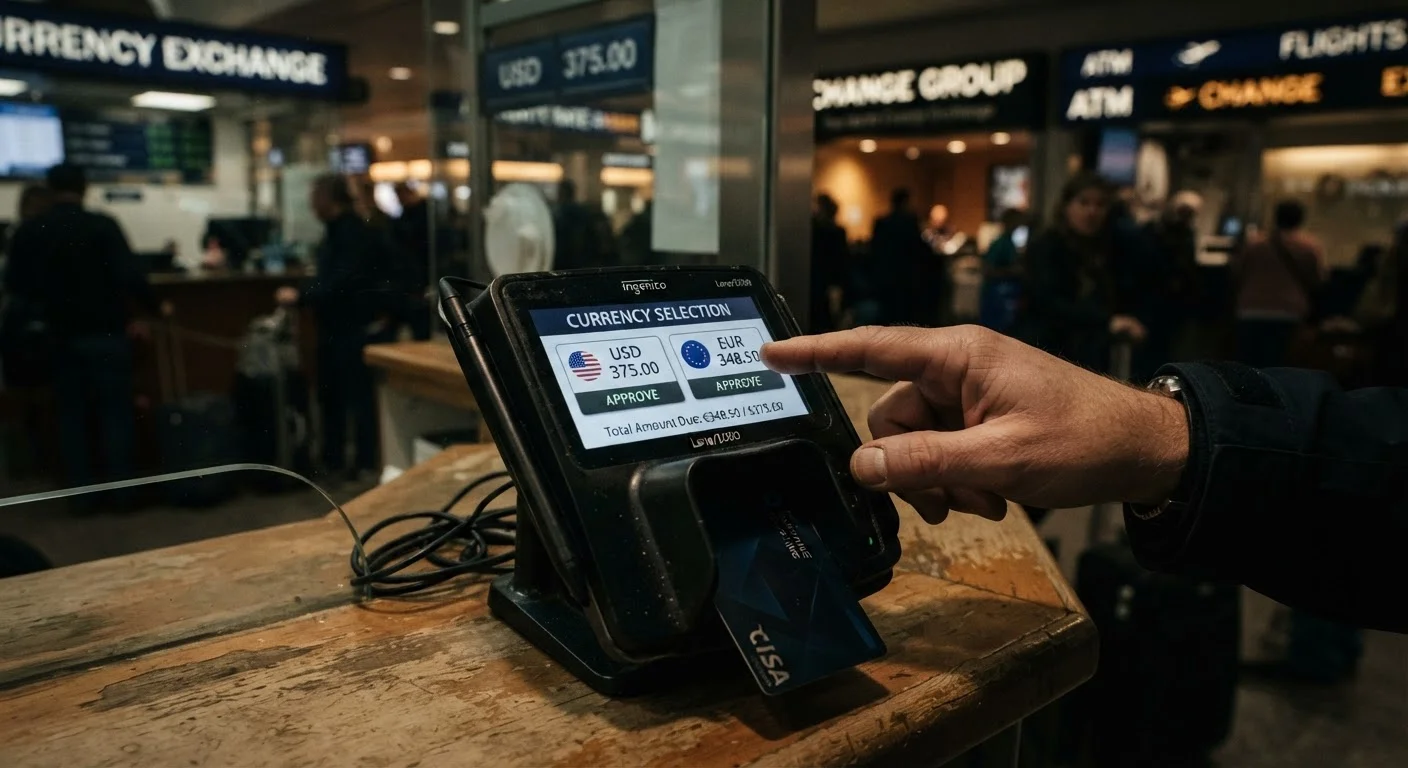
You hand over your card at a restaurant in Rome or a hotel in Tokyo, and the terminal shows a prompt: "Would you like to pay in USD at a guaranteed rate?" It sounds reassuring — you can see exactly what you're spending in dollars. Most first-time travelers tap "yes" without a second thought.
That's exactly what the merchant's payment processor is counting on. Dynamic currency conversion packages a worse exchange rate inside a familiar comfort: knowing the number in your home currency. The "guaranteed rate" language is technically accurate — it guarantees their rate, not a competitive one.
DCC appears across nearly every payment touchpoint abroad: retail card terminals, hotel checkout desks, ATMs, and even some airline ticket counters. Understanding what it is before you're standing at a terminal — tired, jet-lagged, and in a hurry — is the only reliable way to sidestep it.
DCC Is Not the Same as a Currency Exchange
DCC applies at the point of card payment — it's a real-time conversion offered by the merchant's processor. It is distinct from exchanging physical cash at a currency kiosk, though both can involve unfavorable rates. Understanding which type of transaction you're in helps you ask the right question at the right moment.
The Real Cost: Where the Money Goes
When you pay via DCC, the conversion is handled by a third-party processor — not your bank. That processor applies its own exchange rate, which typically sits 3% to 12% above the interbank rate (the baseline rate banks use with each other). Your card issuer's rate, by comparison, usually sits much closer to that interbank benchmark.
Here's a simple illustration: if you're spending €200 and the fair rate puts that at $218, a DCC rate with a 7% markup would bill you approximately $233. That $15 difference feels small, but it compounds across every purchase on a two-week trip.
3–12%
Typical DCC markup above interbank rate
Industry analyses of dynamic currency conversion consistently find markups in this range, with the average closer to 5–7% at common tourist locations.
1–3%
Standard foreign transaction fee by comparison
Most bank-issued credit and debit cards charge 1–3% for purchases processed in a foreign currency — significantly less than a typical DCC markup.
It's also worth noting that DCC doesn't replace your card's foreign transaction fee — it stacks on top of it. So if your card charges a 2% foreign transaction fee and the merchant applies DCC, you're absorbing both costs simultaneously. For a fuller picture of the fees that quietly erode travel budgets, see our guide to foreign transaction fees and ATM charges.
How to Decline DCC Every Time
The mechanics of avoiding DCC are straightforward once you know what to look for:
- At a card terminal: When the screen asks about currency, select the local currency — euros, yen, pounds, etc. If the terminal defaults to your home currency, ask the cashier to rerun the transaction in local currency.
- At an ATM: If the machine offers to convert your withdrawal to USD at a "known rate," decline and choose to be charged in the local currency. The ATM will still dispense local cash.
- At hotel checkout: Confirm with the front desk that your final bill will be charged in local currency before they run the card. Hotels are a common DCC hotspot, especially for large charges.
Set a mental rule before you travel
Decide in advance: always pay in local currency, no exceptions. Making it a fixed rule rather than a case-by-case decision removes hesitation at the terminal when you're tired or rushed. A short note in your phone's travel folder can serve as a quick reminder.
If you're unsure whether DCC was applied, check your statement: a charge listed in your home currency (USD) rather than the local one is a signal DCC was used. Third-party processor names like Fexco or Planet may also appear in the transaction details.
Managing this consistently across a multi-destination trip takes some practice. Managing money across multiple countries covers broader strategies for keeping currency costs under control when you're moving between several destinations.
What DCC Doesn't Change — and What It Does
Declining DCC doesn't make your overseas spending free. Your card issuer may still apply a foreign transaction fee, typically between 1% and 3%, on purchases charged in foreign currency. Cards specifically designed for travel often waive this fee entirely — worth factoring into your card choices before departure.
What DCC does change is who profits from the conversion and how unfavorable the rate is. When you pay in local currency, your card issuer handles the conversion at a rate that's generally close to the interbank rate. When you accept DCC, the merchant's processor handles it at a rate they set — and they have every financial incentive to set it high.
The broader lesson for first-time travelers: the travel industry is full of optional fees that look like services. DCC is a clear example, but it's part of a wider pattern. Hidden costs that inflate a flight's real price follow the same logic — a low headline number that grows once you read the fine print.
This article is for general informational purposes only and does not constitute financial advice. Exchange rates, fees, and card policies vary by issuer and destination. Verify current terms with your card provider before traveling.