Why You Signal More Than You Realize
Opportunistic theft and scams in tourist areas rarely target random individuals — they target people who look uncertain, distracted, or unfamiliar with their surroundings. You don't need to blend in perfectly to reduce your risk. You just need to stop broadcasting that you're lost.
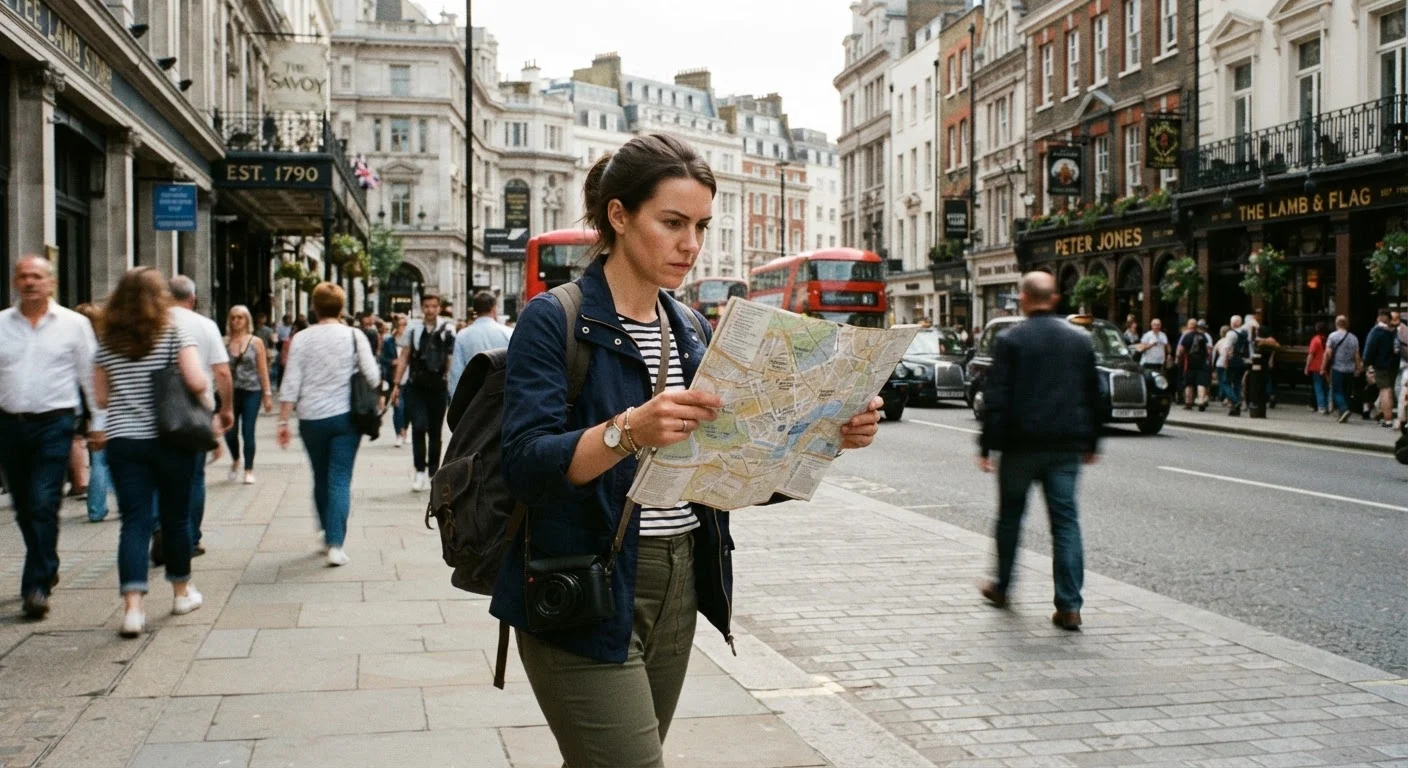
The most common giveaways are behavioral: stopping abruptly on a busy sidewalk to stare at your phone, unfolding a large paper map at an intersection, photographing street signs to figure out which block you're on, or spinning to orient yourself after exiting a transit station. None of these are dangerous on their own, but together they create a profile that people with bad intentions recognize quickly.
The good news is that looking oriented is a learnable habit, not an innate quality. It's mostly about doing your navigation homework before you step outside — so that when you're moving through a city, you're executing a plan rather than figuring one out on the fly. See our guide to situational awareness while traveling for a deeper look at reading your environment without anxiety.
Six Habits That Keep You Looking Oriented and Grounded
These practices aren't about paranoia — they're about removing unnecessary friction and reducing the moments when you look like you're not sure where you are or what you're doing.
Study your route and key landmarks before leaving your accommodation each day.
Walking out already knowing the general direction, a couple of street names, and one visible landmark gives you enough orientation to move without pausing to check constantly. This single habit eliminates most of the confusion signals that mark someone as a tourist.
Use your phone discretely and purposefully, not reactively.
Holding your phone up at street level while you spin around looking for direction arrows is one of the clearest signals that you're disoriented. It also makes your device an easy target. Using your phone briefly and intentionally — then pocketing it — is a meaningful behavioral difference.
Download offline maps before you arrive in a new city.
Connectivity is unpredictable — subway stations, older neighborhoods, and areas with network congestion can all leave you without a signal at the worst moment. Offline maps eliminate that dependency entirely, so you can navigate without looking panicked when data drops.
Walk with intention: keep a steady pace, stay to one side of the sidewalk, and avoid stopping in high-traffic zones.
Hesitant, stop-start movement in busy areas attracts attention and creates physical vulnerability — you're easier to bump into or crowd when you're stationary and uncertain. A steady pace, even if slightly slower than usual, reads as purposeful.
Know the neighborhood context before you go — not just the address.
Arriving at a destination without understanding the surrounding area means you might exit a transit station in the wrong direction, walk through a section that warrants more caution after dark, or be surprised by surroundings that don't match expectations. This isn't about avoiding places — it's about going in informed.
Carry a small printed card with your accommodation address in the local language and script.
If your phone dies, your data fails, or you simply can't find the right transliteration on a map, a printed card lets you show a taxi driver or local exactly where you need to go. It also removes the fumbling with translation apps in a stressful moment.
Quick Actions You Can Take Before Your Next Outing
Most of these habits cost nothing and take under ten minutes. Building them into your routine before leaving your accommodation each day creates a consistent baseline of preparedness.
For more on protecting yourself while moving through transit systems, the end-to-end public transport walkthrough covers everything from planning your route to exiting the right station.
Putting It Into Practice Across Different City Types
Not every city presents the same challenges. Dense, grid-based cities like much of Midtown Manhattan are relatively easy to navigate on foot once you understand the block numbering system. Older cities with organic street layouts — think historic European cores or medina-style neighborhoods — require more pre-trip orientation. If you're heading somewhere with complex wayfinding, check our article on navigating Morocco's medinas or Western Europe's most beginner-friendly cities before you go.
Walkability Varies Significantly by City
Some cities reward confident foot travel with clear signage, well-lit streets, and logical layouts. Others require more planning around transit, timing, and neighborhood familiarity. If you're choosing between destinations partly based on how easy they are to navigate on foot, the walkable US cities guide offers useful context. For transit-heavy cities, the local transit hub has destination-specific breakdowns including a step-by-step London Tube walkthrough.
Back at your accommodation, the habits you build there matter too — from securing valuables to confirming your room is actually in a well-located part of town. The accommodation habits guide covers those foundations. And if you want to go deeper on protecting what you're carrying while you're out, see keeping your belongings safe in unfamiliar places.