
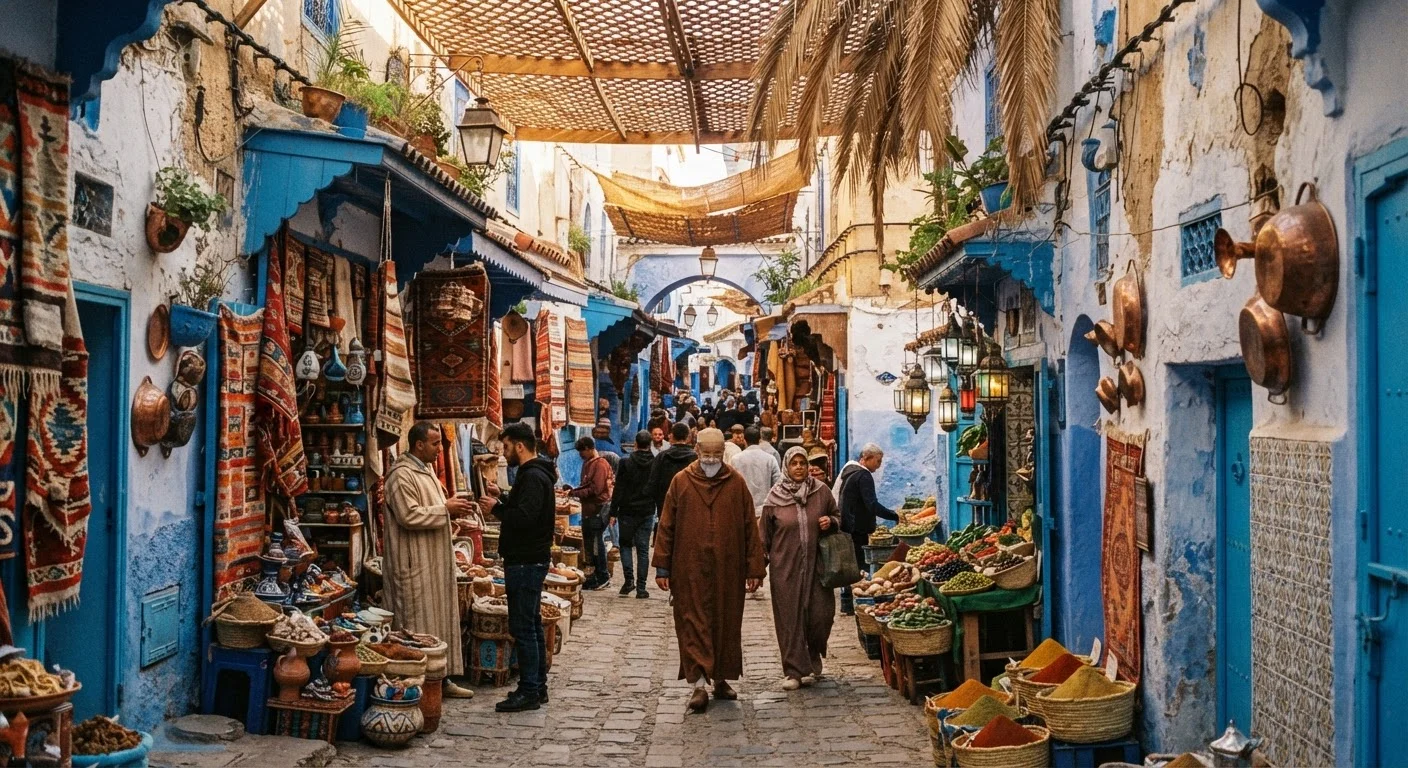
Why Medinas Feel Disorienting — and Why That's Not a Design Flaw
Morocco's historic medinas — including those in Fez, Marrakech, Meknes, and Chefchaouen — were built over centuries as self-contained urban ecosystems. Their dense, irregular street patterns weren't accidents: they evolved organically around trade routes, religious centers, and neighborhood identity. The apparent chaos has an internal logic that becomes legible once you understand what you're looking at.
The medina's structure radiates outward from its spiritual and commercial core. The grand mosque anchors the center; the main souk (market) runs along the primary pedestrian artery; craftsmen's quarters cluster by trade; residential derbs (private dead-end lanes) feed off the outer edges. Tourists experience disorientation largely because they enter expecting a grid and find an organism instead.
Use Your Riad as a Home Base
Before exploring, ask your riad (traditional guesthouse) staff to draw a simple hand-sketch of the surrounding quarter. Mark the nearest major landmark and the main souk entrance. This low-tech map, combined with your offline digital map, covers most orientation gaps and takes under five minutes to create.
Understanding this structure — rather than fighting it — is the single most effective preparation you can do before arriving. The steps below walk you through a practical orientation system that works across Morocco's major medinas regardless of which city you visit first.
What You'll Need Before You Start
What you will need
Offline navigation app
Provides turn-by-turn guidance inside the medina where mobile data signal is unreliable.
Accommodation address in Arabic script
Allows locals or shopkeepers to quickly direct you back to your riad when you're disoriented.
Lightweight day bag with zipper closures
Keeps essentials secure in crowded souk lanes without restricting movement.
Small notebook or phone note with key landmarks
Quick reference for the two or three anchor points you've identified in your quarter.
None of this preparation requires significant expense or technical skill. The most important investment is time: spend 20 minutes with your offline map and your riad's staff before your first solo medina walk, and the experience shifts from stressful to genuinely rewarding.
Know Before You Enter a Mosque
Non-Muslims are not permitted to enter most mosques in Morocco, including the famous Kairouyine mosque in Fez. Attempting to enter restricted religious sites is disrespectful and may result in a confrontation with local authorities. Always look for signage or ask your accommodation in advance which sites are open to visitors.
Step-by-Step: Moving Through the Medina With Confidence
Understand the medina's functional layout before you walk in
Morocco's medinas follow a logic that dates back centuries. The central spine is typically the main souk (market street), which leads outward from a central mosque or medersa (Islamic school). Specialized trade streets — leather workers, spice merchants, coppersmiths — branch off from this spine in clusters. Residential derbs (dead-end alleyways) feed off those trade streets.
Identify three fixed reference points on your offline map before entering: the main mosque or minaret visible above the roofline, the primary souk entrance gate, and your riad's nearest named street or landmark. These three anchors form a mental triangle you can return to mentally whenever orientation slips.
Download and configure your offline map before entering
Mobile data coverage inside thick-walled medina lanes is inconsistent. Download the full offline area for your city before leaving your accommodation. Zoom into your specific quarter and screenshot the block surrounding your riad so you have a backup image even if the app misbehaves.
Set your map app to show your current location using GPS (which works without data) rather than relying on cell-tower positioning. Test this function while still connected to your riad's Wi-Fi so you know it's working correctly.
Walk the main souk spine first, in daylight
On your first day, resist the impulse to immediately branch into side alleys. Walk the full length of the main souk from one gate to the other without stopping for extended periods. Note what trade clusters appear where, which mosques or fondouks (historic merchant inns) mark turning points, and roughly how long the route takes.
This single orientation walk — typically 20 to 40 minutes depending on the medina — gives you a spatial skeleton onto which all subsequent explorations can be anchored.
Use sensory and architectural cues to stay oriented
When your map fails you, the medina itself provides cues. Mosques always face toward Mecca, which in Morocco means they face roughly east-southeast — this gives you a directional reference. The sound of the adhan (call to prayer) from minarets helps locate your position relative to major landmarks.
Trade smells are also consistent: tanneries (most famously in Fez) produce a distinctive odor detectable from several streets away; spice souks have an unmistakable aroma. These sensory anchors are genuinely useful for triangulation when visual cues are ambiguous.
Ask for directions strategically — and safely
When you need directions, approach shopkeepers inside established shops rather than individuals on the street. A shopkeeper has a fixed location and a reputational interest in being helpful. Show them your accommodation's address in Arabic script and ask 'fin kayn?' (where is this?).
Most medina residents are genuinely willing to help without expectation of payment. The habits that reduce your risk in unfamiliar cities apply here too: project calm confidence, avoid displaying expensive items, and keep your phone out of sight when not actively using your map.
Set a return time and stick to it
Medinas change character significantly after sunset. While evenings can be lively and atmospheric — particularly around main squares like Djemaa el-Fna in Marrakech — the deeper residential derbs become genuinely difficult to navigate in low light. Plan to return to your riad before dark on your first two evenings until you have a reliable mental map of your quarter.
Set a phone alarm 45 minutes before your target return time as a buffer. It takes longer to navigate back through a medina than most first-timers expect, especially if the return route involves any unfamiliar turns.
Common Mistakes First-Timers Make — and How to Avoid Them
The most consistent error first-timers make is over-relying on live GPS navigation while simultaneously not downloading offline maps in advance — leaving them with neither working option when they need it. The second most common mistake is entering the medina late in the afternoon on day one, when crowds are at their densest and fatigue is highest.
Unsolicited Guides Are Common
In high-traffic medinas like Fez and Marrakech, strangers may offer to guide you 'for free' before directing you to a shop where a commission is expected. You are under no obligation to accept help or enter any establishment. A polite but firm 'la shukran' (no thank you) is widely understood and respected.
A subtler mistake is treating every wrong turn as an emergency. Medinas are densely populated, daylight is forgiving, and most streets eventually connect back to a landmark you recognize. Mild disorientation is part of the experience — and it becomes less frequent quickly as your mental map fills in. The practical habits for moving confidently in unfamiliar cities are worth reviewing before your trip, particularly the sections on body language and situational awareness, which apply directly to medina navigation.