Before You Leave the Hotel: Route Planning
The single most effective thing you can do is plan your journey before stepping outside. Open the city's official transit authority website or app — most major systems worldwide publish real-time trip planners. Enter your starting point and destination, then note the line name or number, the direction of travel (identified by its terminal station), and any transfer points.
Screenshot or download your planned route for offline use. Cell service inside underground stations is often unreliable. If you're building a full day's itinerary, see how day-by-day trip planning can help you sequence transit legs logically so you're not backtracking.
Save Your Route Before Going Underground
Before leaving your hotel or accommodation, take a screenshot of your planned route including transfer stations and your exit stop name. Underground stations frequently have no cell signal, and a saved screenshot works without data. Google Maps and Citymapper both support offline route viewing in many cities.
Write down the name of the stop where you need to exit and the terminal station name for your line. These two pieces of information are all you need to board confidently and exit correctly.
Understanding Fares, Tickets, and Transit Cards
Most urban transit networks offer three payment methods: single-journey tickets, day passes, and reloadable smart cards (sometimes called travel cards or transit cards). Smart cards almost always offer a lower per-trip fare and eliminate the need to queue at a machine each time.
3–5×
Faster boarding with a transit card vs. single tickets
Transit authorities in multiple major cities report that contactless card and mobile payment lanes process passengers several times faster than cash or paper ticket queues.
40%+
Of transit fines issued for validation errors
Inspection data from several European transit operators indicates that a large share of on-the-spot fines involve tickets that were purchased but not validated, rather than no ticket at all.
To load a smart card, find a ticket machine or service desk at any major station. Insert cash or a debit/credit card, select the reload or top-up option, and add a balance. Keep your card accessible — tapping in and out quickly keeps platforms flowing and avoids fare errors.
If you're visiting a city with a zone-based system (common in Europe and parts of Asia), confirm which zones your journey crosses. Buying a ticket for too few zones is one of the most frequent beginner mistakes and can result in a fine. For a city-specific example of how this works in practice, the London Underground walkthrough explains zone logic in detail.
At the Station: Orienting Yourself
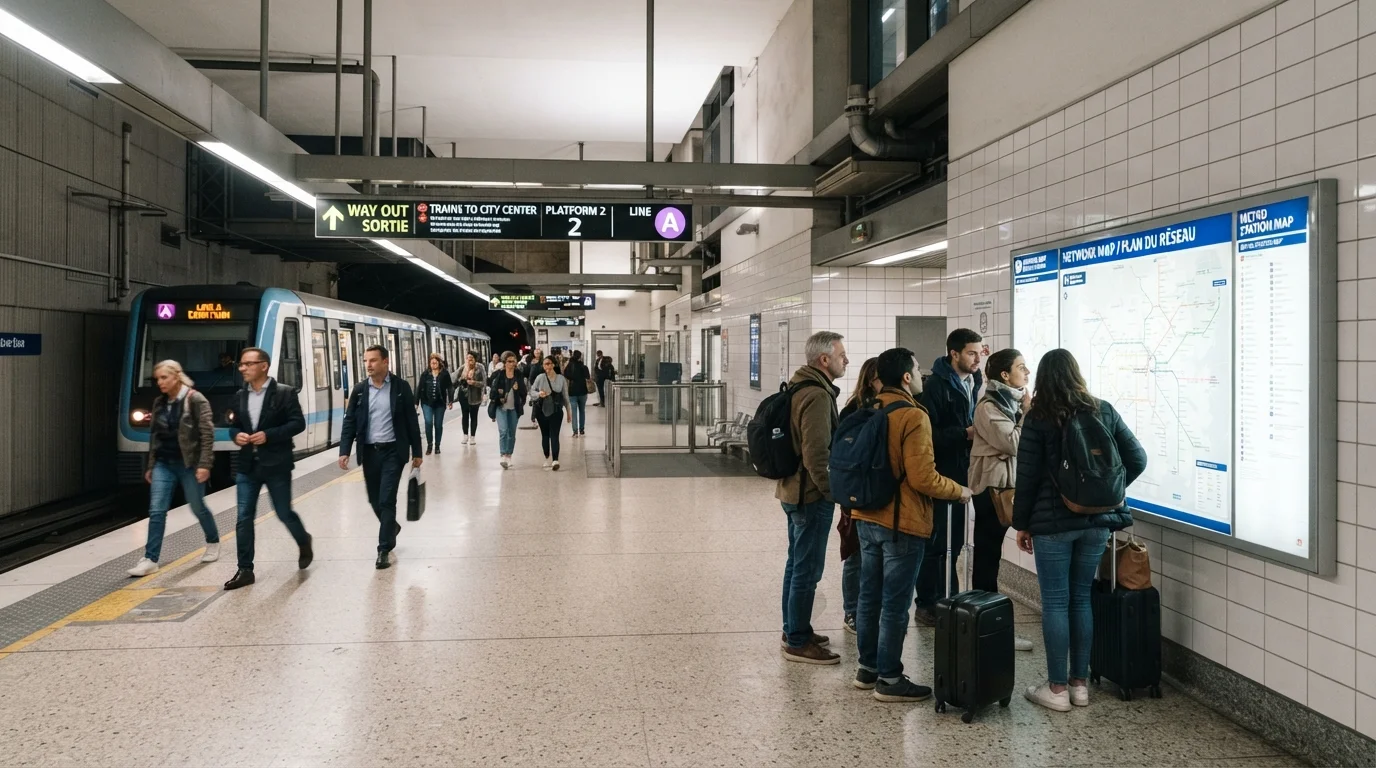
When you enter a station, pause near the entrance and locate three things: the system map, the fare gates or validation machines, and the platform direction signs. Most stations post large network maps near the entrance — take a moment to confirm your route before approaching the gates.
Fare gates require you to tap your card or insert your ticket to open. Validation machines (common on buses and some rail systems in continental Europe) require you to stamp or scan your ticket before boarding, even if no gate checks it — inspectors do board and issue fines for unvalidated tickets. When in doubt, validate.
Use the terminal station name — not compass directions — to find your platform. Every transit sign worldwide uses this convention, making it a universal navigation tool regardless of the city.
Compass directions require you to know which way you're facing underground, which most first-timers don't. Terminal station names are always posted on the platform and eliminate ambiguity entirely.
When transferring between lines, follow the signs continuously rather than stopping to re-plan. Large interchange stations are designed to guide you through if you keep moving and reading each successive sign.
First-time riders often stop mid-transfer and lose the sign sequence, ending up back on a platform they started from. Continuous forward movement through the signed path is faster and less confusing.
Platform direction signs typically show the terminal station name at each end of the line. Match the terminal name on the sign to the one in your planned route notes — this tells you which side of the platform to stand on.
On the Vehicle: Riding With Confidence
Once aboard, open your offline map or notes and begin tracking stops. Most modern metro and bus systems display the next stop on digital screens inside the vehicle and announce it over speakers — but audio can be hard to hear during rush hour, so visual confirmation matters.
Count stops from your boarding point to your exit. If you boarded at stop three and need stop seven, you're looking for the fourth announcement. This simple counting method works regardless of language.
Secure Valuables Before Checking Your Phone
Consulting your phone openly on a crowded transit vehicle is one of the most common situations where opportunistic theft occurs. Review your route plan before boarding, note your stop count, and keep your phone pocketed while standing. If you need to recheck, step to a less exposed position near a wall or seat.
Keep your phone and valuables secured while consulting your route. Standing near the doors on a crowded train with a phone in hand is a common scenario for opportunistic theft. Check your notes before boarding and put the phone away until you're seated or near your stop. For broader awareness habits in new cities, see navigating unfamiliar cities safely.
Exiting the Right Stop and Getting to Your Destination
When your stop approaches, move toward the doors before they open — don't wait until the train halts. Many busy stations have multiple exits (labeled A, B, C or by street name). Check which exit is closest to your destination before leaving the platform; choosing the wrong exit can add several blocks of unnecessary walking.
On systems that require tap-out (where the card is charged based on distance traveled), always tap your card again at the exit gate. Failing to tap out can trigger a maximum fare charge or block your card for future journeys.
Once street-level, orient yourself using a static landmark before opening your phone — the station name sign, a prominent building, or a cross-street marker. This habit, common among experienced urban travelers, prevents the disoriented spinning that signals unfamiliarity to those around you.
Common Mistakes and How to Avoid Them
First-time transit riders tend to make a predictable set of errors. The most consequential are boarding in the wrong direction, skipping ticket validation, and misjudging the last service time of the day.
- Wrong direction: Always verify the terminal station on the platform sign matches your planned route before boarding.
- Skipping validation: On honor-system networks, an unvalidated ticket is treated the same as no ticket. Validate every time, even on short trips.
- Missing last service: Many metro systems stop running between midnight and 5 a.m. Check the timetable for your return journey before you head out for the evening.
- Ignoring transfer time: Transit apps show optimistic transfer times. Add two to three minutes of buffer per transfer, especially in large multi-level stations.
For a deeper look at these and other beginner errors, common transit mistakes and how to avoid them covers each scenario with step-by-step corrections. If your journey begins at the airport, the airport transfer walkthrough picks up from the moment you land.
Transit Rules Vary Significantly by City
Validation requirements, zone structures, tap-in/tap-out rules, and card types differ between cities and even between lines within the same city. Always check the official transit authority's website for the specific city you're visiting. General guidance in this article reflects common patterns, not universal rules.