
Why Day-by-Day Planning Matters
Most first-time travelers either over-plan — filling every hour until the trip becomes a to-do list — or under-plan, arriving with only a vague idea of what to do. A day-by-day structure sits in the middle: it gives you enough organization to feel confident without locking you into an exhausting itinerary.
The practical benefit is simple. When you know what's happening on Tuesday, you can confirm restaurant reservations, check museum hours, and arrange transport in advance. You avoid arriving at a closed attraction or scrambling for a taxi at the wrong time. You also protect your budget — last-minute alternatives are almost always more expensive. Before structuring your days, make sure your overall spending plan is in place. Our guide to building your first trip budget walks through how to estimate costs before you commit to anything.
Day-by-day planning works for any trip length
Whether you're traveling for three days or three weeks, the same framework applies. Shorter trips benefit from more structure because there's less margin for wasted time. Longer trips benefit from more built-in flexibility, since fatigue accumulates and your interests may shift once you're actually there.
Before You Build the Schedule: Lay the Foundation
Day-by-day planning only works when three things are already settled: your destination, your accommodation, and your travel dates. If those are still in flux, start with the destination-selection process first — your daily options depend entirely on where you'll be and for how long.
Once those anchors are in place, gather the raw material for your itinerary:
- A list of everything you want to see or do — don't filter yet, just capture it all.
- Opening hours and entry requirements for each attraction. Many popular sites require advance ticket purchases or have limited entry windows.
- A rough sense of the geography — which neighborhoods or areas cluster together, and how long it takes to travel between them.
- Any fixed commitments — pre-booked tours, dinner reservations, or event tickets that anchor specific days.
Having this information in one place before you start building days prevents constant re-shuffling later. For hotel check-in times and policies, see our hotel booking walkthrough — these details affect how you plan your arrival day specifically.
Structuring Each Day: A Practical Framework
Think of each travel day in three zones: morning, afternoon, and evening. Assign one primary activity to each zone, then connect them logically by location.
The location-grouping principle is the most useful single habit in itinerary building. If a museum and a market are both in the same district, pair them on the same day — even if the museum was your top priority and the market was an afterthought. Backtracking across a city to fix poor sequencing wastes an hour or more of actual trip time.
Group by neighborhood, not priority
When sequencing activities, resist the urge to order them by how excited you are about each one. Instead, group them by where they are. Visiting your favorite attraction first and then backtracking across town to see something nearby is a common scheduling mistake that adds unnecessary time and fatigue to your day.
Within each zone, allow a realistic buffer — roughly 30 to 45 minutes — between activities. This absorbs slower-than-expected meals, long queues, or the simple desire to linger somewhere you enjoy. Over-scheduling is one of the most common reasons itineraries collapse; see our article on why itineraries fall apart on day two for a detailed breakdown of the most frequent planning errors.
If you're managing multiple cities, the grouping principle applies at a larger scale. Our guide to structuring a multi-city trip covers how to pace travel days between destinations without burning out.
Buffer time
Intentionally unscheduled time built into a travel day to absorb delays, slow meals, or unexpected detours without derailing the rest of your plan.
Anchor activity
A confirmed, pre-booked event or reservation that fixes a specific time slot in your day, around which everything else is arranged.
Location grouping
The practice of scheduling activities in the same geographic area on the same day to minimize transit time between stops.
Optional item
An activity on your itinerary that has no reservation attached — it can be moved, skipped, or replaced without affecting confirmed bookings.
Transit time
The real-world travel time between two locations, including walking, waiting, and boarding — often longer than map distance alone suggests.
Arrival and Departure Days Deserve Special Attention
These two days are the most commonly under-planned — and over-planned — of any trip. Arrival days are often treated like full travel days when they're actually half-days at best. Factor in time to reach your accommodation, check in, orient yourself, and decompress. Plan one relaxed activity at most: a walk through a nearby neighborhood, a casual local meal, or an early evening rest.
Departure days carry a different risk: travelers try to squeeze in one last major attraction before heading to the airport, then panic when checkout and transport take longer than expected. A practical rule is to stop planning activities on departure day at least three hours before you need to leave for the airport or station, and to double that buffer for international flights. Confirm checkout time with your hotel at check-in — not the morning you're leaving.
If your trip involves a cruise rather than a hotel-based itinerary, port arrival and departure days operate under tighter constraints. The first cruise walkthrough explains how embarkation and disembarkation days differ from standard travel days.
Keeping Your Plan Flexible Without Losing Control
A good day-by-day itinerary is a guide, not a contract. Build in at least one unscheduled half-day across your trip — ideally mid-trip, not at the end. This slot absorbs delays, weather changes, or an unexpected place you want to explore further.
The distinction between confirmed and optional items matters here. Mark anything with a reservation or ticket as confirmed and non-movable. Everything else is optional — it stays on your list but can shift without disrupting the trip. When something gets cut, you're choosing from your optional list rather than scrambling.
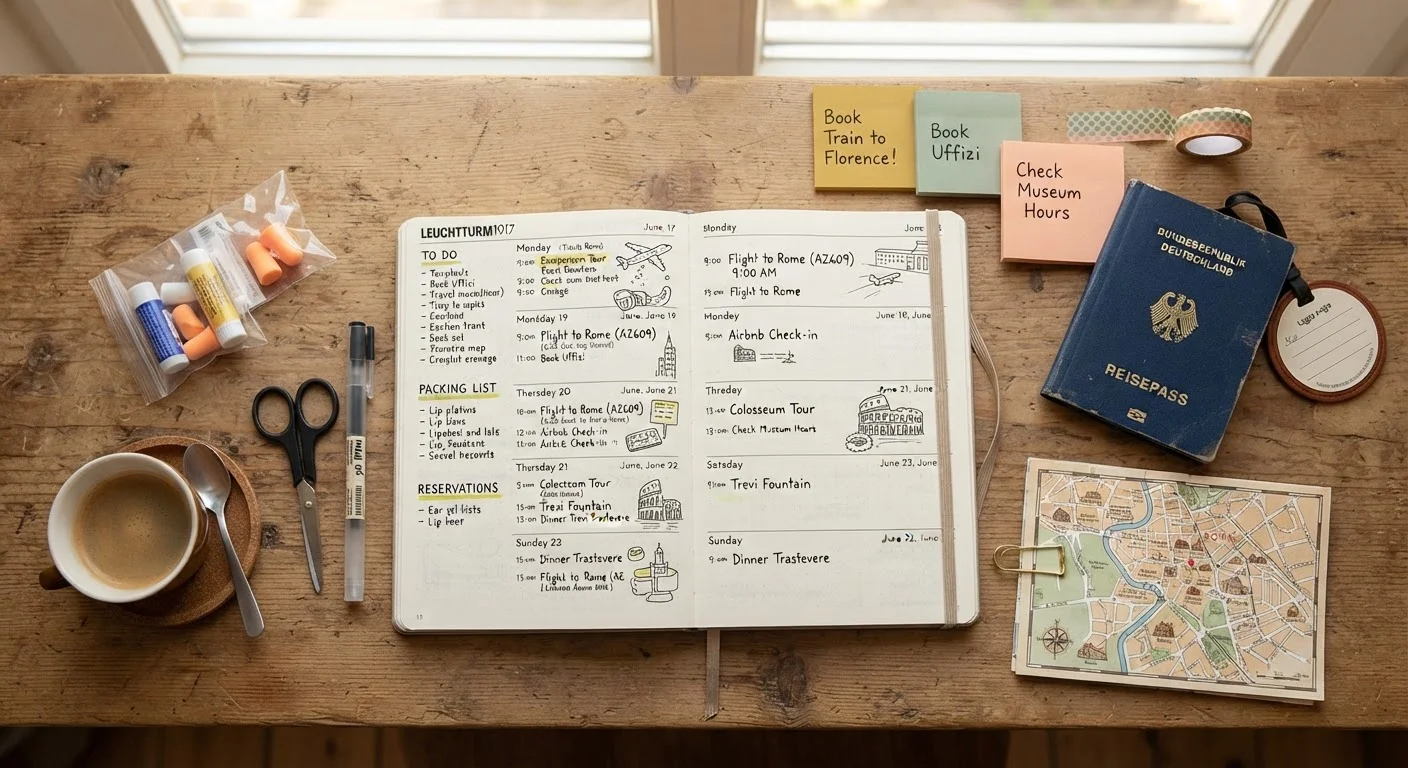
For the actual tool you use to organize this, whether that's a spreadsheet, an app, or a paper notebook, the format is less important than the consistency. Our comparison of digital tools vs. paper planning can help you decide what fits your style. What matters most is that your plan lives somewhere you'll actually check each morning before you head out.
Itinerary Spreadsheet Template
A simple day-by-day spreadsheet structure helps you slot activities into morning, afternoon, and evening zones while tracking confirmed versus optional items in one view.
Official Tourism Board Websites
Most destinations have an official tourism or visitor authority website listing current opening hours, entry requirements, and ticketed events — a reliable starting point for verifying details before you travel.
Travel conditions, entry requirements, and attraction hours can change. Always verify details directly with official sources and providers before your trip.