What You Are Actually Looking At
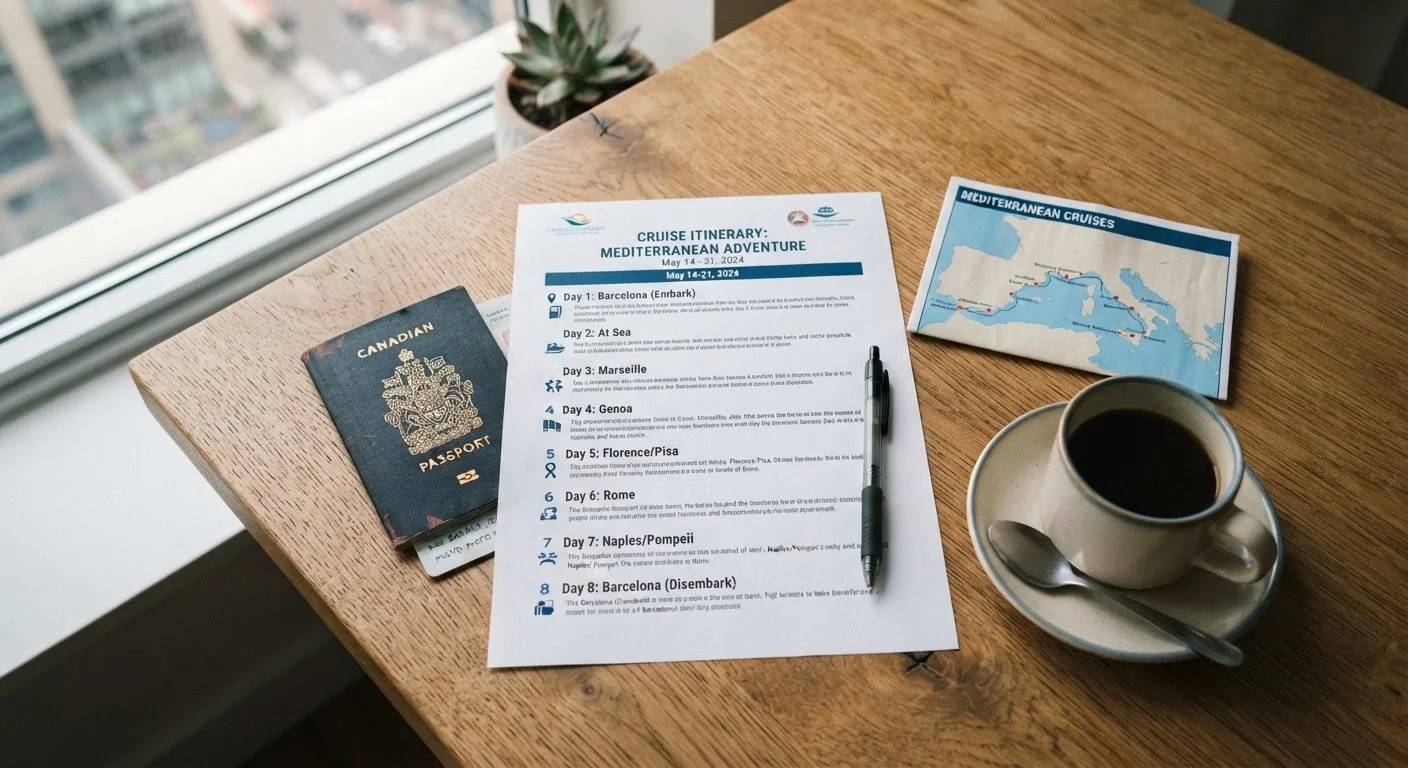
A cruise itinerary is a day-by-day schedule of your voyage. At its most basic, it is a table with five columns: the date, the destination (or "At Sea"), the arrival time, the departure time, and sometimes an all-aboard time. Some cruise lines add columns for the port's time zone or whether tendering is required. Every piece of information in that table has a practical consequence for how you plan your day.
First-time cruisers often treat the itinerary as a loose overview rather than an operational document. In practice, it is closer to a flight schedule — the times matter, and misreading them has real consequences. The good news is that once you understand what each column means, the document becomes straightforward to use.
What you will need
Cruise itinerary document
The primary document listing each day's date, location, arrival time, departure time, and day type.
Time zone converter
Used to compare ship time against local port time so you never miscalculate all-aboard deadlines.
Port map or destination guide
Helps you estimate travel time from the dock to attractions so you can plan port days realistically.
Following the Steps: How to Read Each Day
Work through your itinerary one day at a time using the process below. Pay particular attention to all-aboard times, time zone notes, and tender flags — these three elements cause the most confusion for first-time cruisers. If you encounter terminology that is unfamiliar, our plain-language cruise glossary defines every term you are likely to see. For a broader understanding of how the overall structure of an itinerary shapes your trip experience, this guide to itinerary design is a useful companion read.
Identify the day type for each row
Every line of your itinerary is either a port day (the ship docks or anchors at a destination) or a sea day (the ship sails without stopping). Some itineraries also label a transit day for canal crossings like Panama. Knowing the day type tells you immediately whether to plan activities ashore or onboard. For a deeper look at how these day types shape the overall feel of a voyage, see how itinerary design affects the pace and cost of a cruise.
Read the arrival and departure times carefully
Port days show two times: when the ship arrives and when it departs. The departure time is the ship's scheduled sailing time — not your personal deadline. Your deadline is the all-aboard time, which is printed separately and is typically 30 to 60 minutes before departure. If the itinerary does not list an all-aboard time explicitly, subtract 30 minutes from the departure time as a working rule and confirm with the ship's daily program once onboard.
Check whether times are in ship time or local port time
Cruise itineraries typically list times in local port time, but the ship's onboard clock may be set differently — especially on repositioning voyages crossing multiple time zones. Always check the ship's daily newsletter (distributed the evening before each port day) to confirm which clock applies. When in doubt, ask guest services. A one-hour mismatch between your watch and the ship's clock is a common and avoidable mistake.
Note which ports are tender ports
Some ports cannot accommodate a large ship at a dock. Instead, the ship anchors offshore and passengers ride a small vessel — called a tender — to reach land. Your itinerary may flag these explicitly, or you may see the word "anchor" instead of "dock." Tender operations add 20–40 minutes each way to your morning and afternoon, and they can be suspended in rough seas, which can shorten or cancel your time ashore. Budget extra time accordingly. If unfamiliar terms like "tender" trip you up, our cruise glossary for first-timers covers the full vocabulary.
Plan your port days using the time window, not the full day
Your usable time in port is the window between when you realistically get ashore (accounting for disembarkation queues and tender transfers) and the all-aboard time. For a port with an 8:00 AM arrival and a 5:00 PM departure, a realistic all-aboard might be 4:30 PM — giving you roughly seven hours ashore, not a full day. Use a port map to estimate travel time from the pier to your planned destinations so you build a realistic, not optimistic, schedule. For guidance on making the most of days when the ship keeps sailing, see getting the most out of sea days onboard.
Treat the itinerary as a plan, not a guarantee
Cruise lines reserve the right to alter itineraries due to weather, mechanical issues, or port authority decisions. A port may be skipped or substituted; a sea day may replace a port day. When you book, review the cruise contract's language around itinerary changes. This is not cause for alarm — it is standard practice — but it does mean you should avoid making non-refundable onshore bookings that depend entirely on a single port visit.
Download the Itinerary Before You Sail
Save a PDF copy of your itinerary to your phone before embarkation day. Onboard Wi-Fi can be slow or expensive, and having your schedule offline means you can reference arrival times and port names without connectivity. It also helps if you need to brief a tour operator or taxi driver about your all-aboard deadline.
Itinerary Times Can Shift After Booking
Cruise lines occasionally adjust port arrival or departure times in the weeks before sailing — sometimes by several hours. Log in to your booking portal periodically in the lead-up to your cruise and re-read the itinerary. Do not rely solely on the version you saved at time of booking. Entry and visa requirements for each port should also be verified with official government sources, as they change independently of the cruise schedule.
Missing All-Aboard Is Your Responsibility
If you are not back on the ship by all-aboard time, the vessel will depart without you. Catching up to the ship at its next destination — including flights, hotels, and transfers — is entirely your cost. Travel insurance that covers missed ship departures can provide a financial safety net, but it does not guarantee the ship will wait. Always know your all-aboard time before leaving the pier.
Common Points of Confusion — Resolved
Even after reading the itinerary carefully, a few questions come up repeatedly among first-timers:
- "The itinerary shows 8:00 AM arrival but it's 9:15 AM and we're still sailing." Ships sometimes arrive early or late. Use arrival time as an estimate; the ship's PA system will announce when it is cleared by port authorities and passengers may disembark.
- "My itinerary says 'overnight in port' — does that mean two port days?" Yes. An overnight means the ship stays docked or anchored through the night, giving you access to that destination across two days. Check both days' departure times carefully.
- "The time zone column shows a different time than what I see outside." The ship may be operating on a different clock than the local port to maintain schedule consistency. Trust the ship's daily program over your phone's automatic time update while docked.
Reading a cruise itinerary shares some conceptual overlap with interpreting other travel documents. If you are also navigating flight schedules, our guide to flight search results pages applies similar plain-language logic. Once you are comfortable with your itinerary, the next planning step is your cabin location — reading a cruise ship deck plan follows the same methodical approach.