
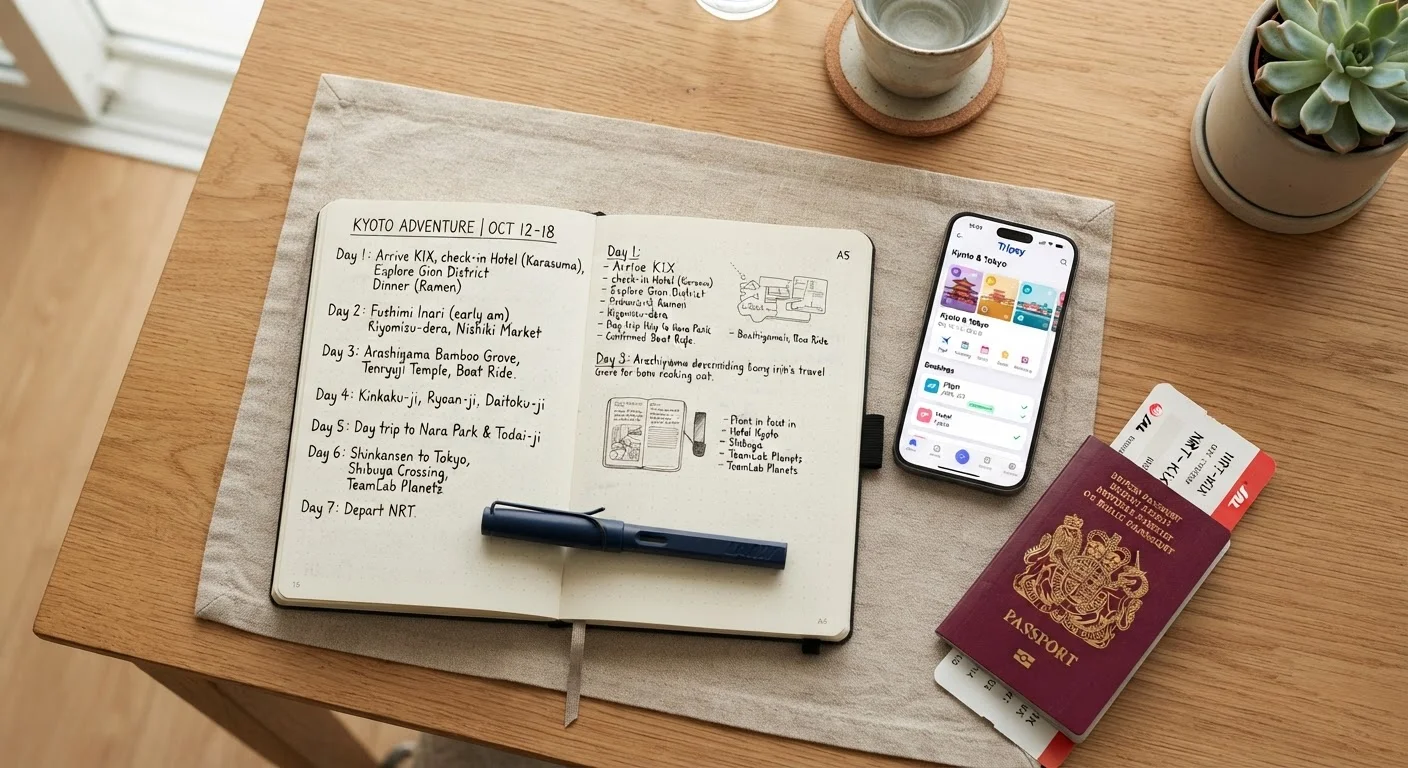
Why Your Planning Format Actually Matters
New travelers often spend hours researching destinations but give almost no thought to how they'll organize that information. Yet the format you choose — digital or paper — shapes how easily you can adapt when flights change, how quickly you find a hotel address at midnight, and whether your plan survives a dead phone battery in a foreign city.
This isn't a minor detail. A poorly organized itinerary is one of the most common reasons first-timers feel overwhelmed on the road. See our step-by-step day-by-day planning walkthrough for how to structure the content itself — this article focuses on which format best holds that structure together.
| Digital Tools | Paper Planning | |
|---|---|---|
| Reliability without power/signal | Requires charge and connectivity | Works anywhere, anytime |
| Ease of editing | Instant updates, easy restructuring | Requires rewriting or correction fluid |
| Sharing with travel companions | Real-time shared access | Must be physically copied or photographed |
| Learning curve | Varies by tool; some setup required | None — universally familiar |
| Backup and recovery | Cloud backup survives device loss | Lost if misplaced or damaged |
| Screen fatigue | Adds to screen time | Keeps phone in pocket |
| Best trip type | Multi-city, group, complex trips | Short, simple, or remote-destination trips |
What Digital Itinerary Tools Do Well
Digital tools — from shared spreadsheets and note apps to dedicated trip-planning platforms — offer capabilities that paper simply cannot match. The most practical advantages include:
- Cloud sync and backup: Your plan is accessible from any device and survives a lost or stolen phone.
- Easy editing: When a museum turns out to be closed on Mondays, you can restructure your day in seconds.
- Shareable access: Travel companions can view or edit the same document in real time, reducing coordination friction.
- Offline download options: Many apps let you save maps, bookings, and notes for offline use — critical in low-signal areas.
- Integration with bookings: Some tools automatically pull in confirmation emails, reducing manual data entry.
If your trip involves multiple cities, a group, or a complex transport chain — such as a cruise with pre- and post-voyage extensions — digital organization tends to scale far more gracefully. For cruise-specific planning needs, the Plan a Cruise hub outlines what details you'll want captured before embarkation.
Download Offline Before You Leave
If you're using a digital tool, take five minutes before departure to save your itinerary, accommodation addresses, and key maps for offline access. Many apps offer this as a specific feature — look for a 'save offline' or 'export' option. This single step prevents the most common digital planning failure: arriving somewhere with no signal and no accessible plan.
Where Paper Planning Still Holds Up
Paper has real, practical advantages that digital enthusiasts tend to underestimate until they're standing in a train station with a dead phone and a connecting departure in eight minutes.
- Zero dependency on power or signal: A printed or handwritten plan works everywhere, always.
- Faster to scan: A single sheet with the day's key details — hotel address, check-in time, dinner reservation — is often quicker to read than navigating through an app.
- Reduces screen time: Many travelers find that constant phone use fragments their experience. A paper itinerary lets you put the phone away.
- No learning curve: There's no app to install, no account to create, and no interface to figure out while jet-lagged.
Paper also pairs well with analog expense tracking. If you're using a simple notebook to log daily spending alongside your schedule, our guide to tracking spending while traveling covers approaches that work without requiring a dedicated app.
The Practical Case for Combining Both
The most durable approach for first-time travelers is a hybrid: build your itinerary digitally, then print or hand-copy a one-page daily summary to carry with you.
This gives you the editing flexibility of digital tools during the planning phase, cloud backup in case devices are lost, and a paper fallback for the moments when technology fails. Use the itinerary planning checklist to make sure neither version misses critical details like emergency contacts, transport confirmation numbers, or accommodation addresses.
One caution: avoid over-planning in either format. A tightly scheduled itinerary — paper or digital — can make a trip feel like a series of tasks rather than an experience. Our article on leaving blank space in your travel schedule explains why unscheduled time is a feature, not a flaw.
Don't Let the Format Become the Project
A common first-timer trap is spending more time perfecting the itinerary document than actually planning the trip. Color-coded spreadsheets and elaborately structured apps can create an illusion of preparedness while leaving real gaps — like not knowing a key attraction requires advance booking. Keep your format simple enough that you can actually use it under travel stress.
Choosing What Works for You
Rather than defaulting to whatever feels most familiar, consider a few practical questions before committing to a format:
- How comfortable are you with apps? If setting up a new tool adds stress rather than reducing it, paper is the better starting point.
- How reliable is connectivity at your destination? Rural, remote, or politically restricted regions may limit your ability to rely on cloud-based tools.
- Are you traveling alone or with others? Shared digital documents remove the need to manually update everyone when plans shift.
- How detailed is your plan? A weekend trip with two activities and one hotel needs far less infrastructure than a two-week multi-country journey.
If your trip involves significant local transit — navigating metro systems, regional trains, or bus networks — it's also worth reviewing transit apps worth understanding before you land so you know which tools to have ready before arrival, regardless of how you organize your broader itinerary.