The Rate You See vs. the Rate You Get
When you search "USD to EUR" online, the number that appears is the mid-market rate — the global benchmark used between banks when they trade currencies with each other. Think of it as the wholesale price of currency. As a traveler, you will almost never receive this rate directly. Instead, every service that handles your conversion — a bank, an exchange kiosk, an ATM abroad — adds a markup on top of it.
That markup is how currency exchange providers make money, and it's built directly into the rate they quote you. A provider offering 1.08 EUR per dollar when the mid-market rate is 1.12 is applying roughly a 3.5% markup. It may look like a simple number, but it functions exactly like a fee — one that's easy to miss because it's invisible on your receipt.
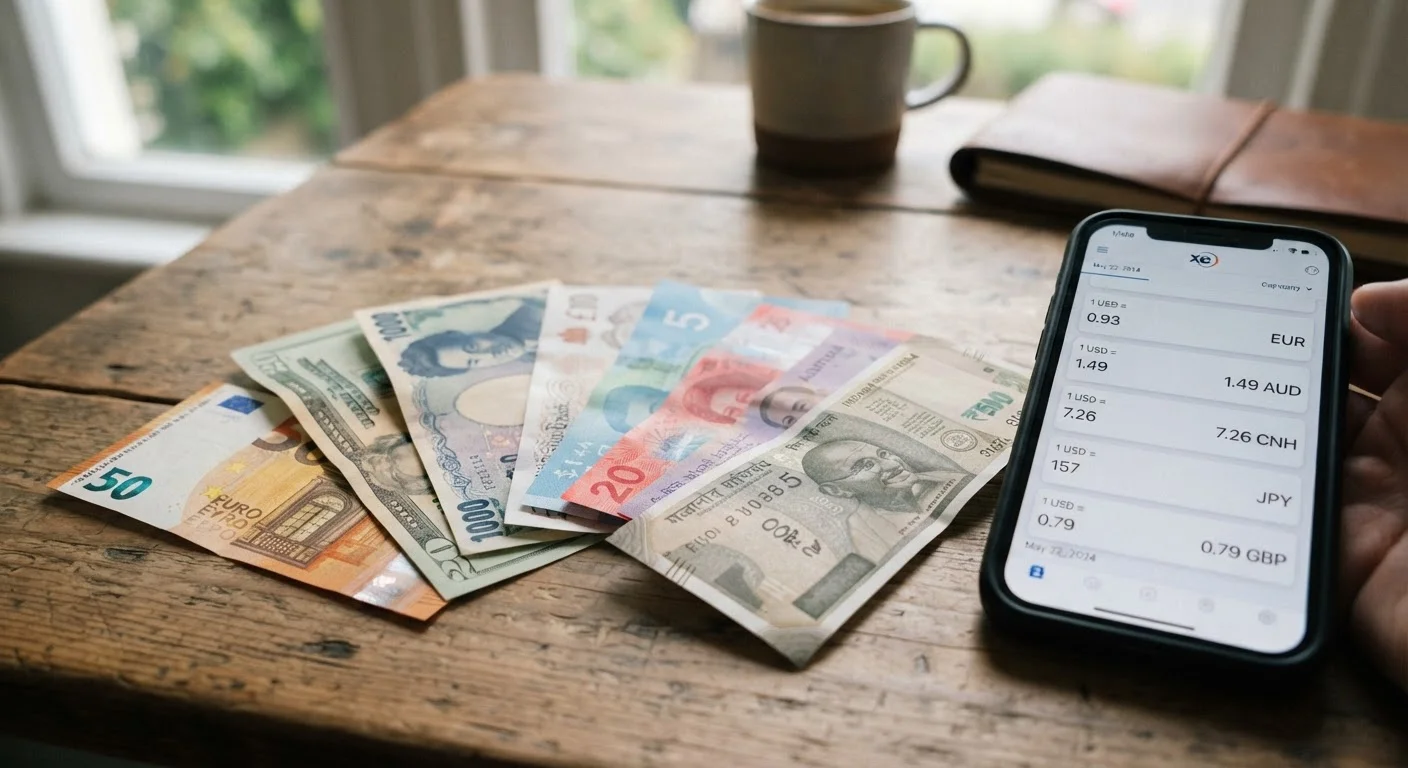
Before any international trip, spend two minutes looking up the current mid-market rate for your destination's currency. That single step gives you a reference point that makes every other quote you encounter legible. See our guide to travel money basics for a broader overview of managing finances abroad.
~3–10%
Typical markup range above mid-market rate
Airport and hotel exchange desks are generally at the high end; travel-optimized cards are often at or near zero markup.
$100+
Markup cost on a $2,000 travel budget at 5%
Even a mid-range 5% markup on a modest travel budget amounts to meaningful lost spending power over a week abroad.
Where Markups Hide — and Where They're Worst
Not all exchange points are equal, and the differences are significant enough to affect your real trip budget. Here's how the common options typically stack up:
- Airport kiosks and hotel desks: Convenient, but routinely the highest markups you'll encounter — sometimes exceeding 10% above mid-market. Use these only as a genuine last resort for a small amount of emergency cash.
- Traditional bank exchanges: More reasonable than airport kiosks, but markup rates still commonly range from 2% to 7% depending on the institution and your account type.
- ATMs abroad: Usually offer rates close to the interbank rate, though foreign ATM fees and your own bank's out-of-network charges can add up. Network fees are separate from the exchange rate itself.
- Travel-focused debit and credit cards: Some cards pass through the mid-market rate with no added markup, though their fee structures vary — always read the terms before relying on one abroad.
Understanding these differences is also the foundation for navigating foreign transaction fees and ATM charges, which layer additional costs on top of exchange rate markups.
Set a Rate Benchmark Before You Go
Before your trip, search the currency pair (e.g., USD to EUR) on any major financial data site to find the current mid-market rate. Write it down or screenshot it. When you're at an exchange desk or reviewing a card statement, you'll immediately be able to see how far off a quoted rate is — and whether it's worth looking for a better option.
Dynamic Currency Conversion: A Common Trap
At restaurants, shops, and ATMs across many popular tourist destinations, you may be offered a choice: pay in the local currency, or pay in US dollars. This option is called dynamic currency conversion (DCC), and while it sounds convenient, it almost always works against you.
When a merchant converts the charge to dollars at the point of sale, they apply their own exchange rate — typically with a markup well above what your card would charge. Choosing to pay in local currency and allowing your card's network to handle conversion is almost always the lower-cost option.
The general rule: when given a choice of currency at a foreign terminal, select the local currency. If you're uncertain how your card handles international transactions, check with your card issuer before you depart.
Building Exchange Rates Into Your Trip Budget
Exchange rates have a direct effect on how far your travel dollars stretch — and they shift daily. A currency that strengthens against the dollar between when you plan and when you travel means every purchase costs you more. A weakening currency goes the other way. While you can't predict movements, you can budget with enough margin to absorb modest fluctuations.
A practical approach: use the current mid-market rate to calculate your baseline costs in USD, then add a buffer of roughly 5–8% to account for the markups you'll inevitably pay across various transactions. This gives you a realistic spending envelope rather than an optimistic one.
For trips that span multiple currencies, the complexity multiplies. The guide to managing money across multiple countries covers how to think through cash planning and fee minimization when crossing borders. And if you're still deciding where to go, how your budget shapes your destination options explains how a destination's cost of living interacts with exchange rates to affect your real-world purchasing power — often more than the flight price does.
This article provides general financial information for educational purposes only. It is not personalized financial advice. Consult a qualified financial professional for guidance specific to your situation.