
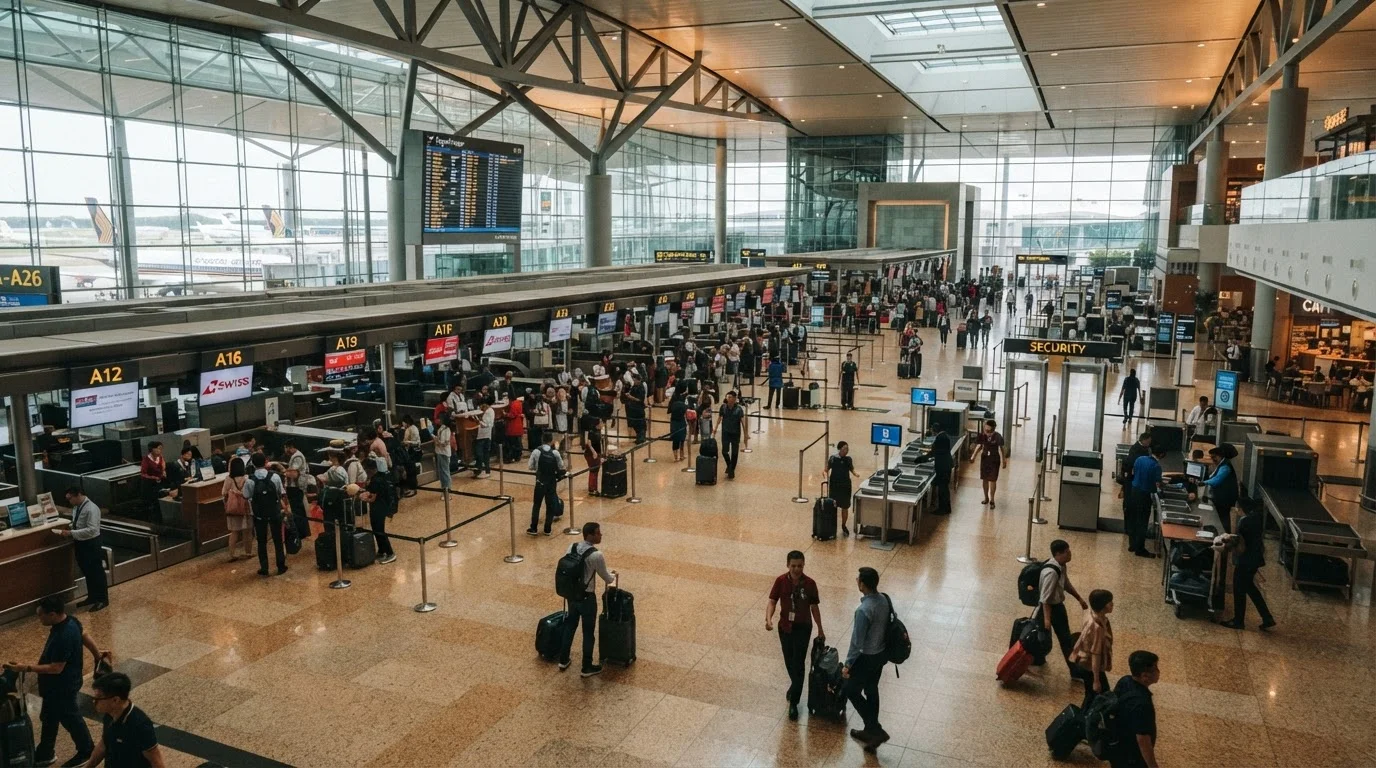
What Actually Happens in Those Two or Three Hours
Most people picture the airport as a single step: show up, get on the plane. In reality, departing involves four distinct checkpoints, each running on its own clock and each capable of producing a line.
- Check-in and baggage drop. Even if you checked in online, checked bags must reach the airline's bag-drop counter before a hard cutoff - typically 30 to 45 minutes before departure for domestic flights, and longer for international ones.
- Security screening. TSA lines are genuinely unpredictable. A quiet Tuesday morning and a Friday afternoon before a long weekend at the same airport can differ by 40 minutes or more.
- Reaching your gate. Large hub airports - think Atlanta, Chicago O'Hare, or Dallas/Fort Worth - can require a 15-minute walk, a train ride, or both between the security exit and your gate.
- Boarding. Airlines begin boarding 30 to 40 minutes before departure and close the gate 10 to 15 minutes before pushback. Arriving at the gate as boarding ends is already cutting it dangerously close.
These steps happen in sequence, not in parallel. A delay at one stage compounds every stage that follows. That's the core reason the two-hour and three-hour guidelines exist - they account for the realistic worst case at each step, not the optimistic one.
Check Your Airline's Specific Deadlines
Every airline publishes its own check-in and bag-drop cutoff times in its conditions of carriage. These can vary by route, airport, and fare class. Look them up on your airline's website before travel day - don't rely on general estimates alone.
Factors That Make the Window Longer
The standard guidelines are starting points, not ceilings. Several common situations push the required time higher.
2 hrs
Minimum recommended arrival for domestic U.S. flights
This is the general guidance published by most major U.S. airlines for domestic departures.
3 hrs
Minimum recommended arrival for international flights
International departures involve additional document checks and often separate terminal processing, extending the required buffer.
10-15 min
Typical gate close time before departure
Most U.S. carriers stop accepting passengers at the gate 10 to 15 minutes before the scheduled departure time.
- Checked baggage. If you're dropping a bag, factor in the bag-drop line on top of everything else. On a busy travel day, this alone can add 20 to 30 minutes.
- Peak travel periods. Holiday weekends, spring break, and summer months compress security staffing against passenger surges. TSA's own data consistently shows longer average wait times during these windows.
- Unfamiliar airports. First-time travelers at an unfamiliar airport routinely underestimate gate distances and terminal layouts. What looks short on an airport map often isn't.
- International departures. International flights add passport control, additional airline document checks, and sometimes a separate international terminal. Three hours is a minimum, not a cushion.
Understanding what slows first-time travelers down can help you anticipate these friction points before they catch you off guard.
The Psychology of 'I'll Make It'
One of the most common reasons travelers miss flights is optimism bias - the tendency to assume the best-case scenario will apply to them specifically. "I've seen people get through security in ten minutes, so I'll be fine." The problem is that this reasoning collapses the moment anything goes slightly wrong: a long line, a misplaced ID, shoes that trigger a secondary screen, or a gate change announced after you've already sat down in the wrong terminal.
“The airport is not a place where things go wrong - it's a place where small delays stack on top of each other. The margin you build in at the start is the only thing standing between a calm flight and a missed one.”
— Aviation passenger experience researcher, Independent researcher specializing in airport passenger flow and travel behavior
Airlines are not obligated to hold a flight because passengers are in the building. The gate close time is a real, enforced boundary. Unlike a hotel, where a late check-in is usually manageable (see our note on how hotel check-in timing works), a missed flight cutoff cannot be reversed by simply waiting a few minutes longer.
If you find yourself with significant time before your flight after clearing security, that's a success, not a waste. Our guide on making the most of airport waiting time covers practical ways to stay comfortable and unstressed at the gate.
A Practical Arrival Checklist
Use this framework to decide when to leave for the airport on travel day:
- Start with the standard window: two hours domestic, three hours international.
- Add 30 minutes if you have checked bags.
- Add 30 minutes if you're traveling during a holiday or peak period.
- Add 15 to 20 minutes if you're unfamiliar with the airport layout.
- Account for your drive or transit time to the airport - and build in buffer for traffic.
If you've handled online check-in in advance, you may be able to reclaim some time at the counter, but don't subtract more than 15 to 20 minutes overall. Security and gate distance are unaffected by how you checked in. For a deeper look at how that process works, see our comparison of online check-in vs. airport check-in.
Arriving early is one of the simplest, lowest-cost decisions you can make on travel day. The alternative - arriving exactly on time and hoping every step goes smoothly - is a gamble with expensive consequences.