Why a Travel Budget Matters Before You Book Anything
A travel budget is not a restriction — it is a decision-making framework. Without one, every purchase on the road becomes a guess, and small overspends compound quickly into financial stress. For first-time travelers especially, having a number to work toward transforms an overwhelming planning process into a series of manageable choices.
The biggest budgeting mistake new travelers make is treating cost as something to figure out later. By the time flights, hotels, and tours are booked, discretionary room has already shrunk. Starting with a realistic total number — and then reverse-engineering what that allows — puts you in control from day one.
For a full picture of how to handle money once you're abroad, including currency exchange and payment methods, see our complete travel money planning guide. This article focuses on the budgeting process itself, from pre-trip estimation through post-trip review.
Set Your Total Number Before You Browse
Looking at flights and hotels before you've set a total budget almost always leads to spending more than you intended. Anchor to a realistic total first — based on your savings, income, and trip length — then work backward into what each category can cost. This sequence protects you from the common trap of falling in love with an option you can't actually afford.
How to Estimate Your Total Trip Cost
Accurate estimation starts with research, not guessing. Use three inputs: destination cost level, trip duration, and your intended travel style.
Step 1 — Set a destination baseline. Research average daily costs for your destination. Travel forums, government tourism boards, and cost-of-living databases can provide ballpark figures for accommodation, meals, and local transport. These vary enormously: a week in a major European capital costs far more than a week in Southeast Asia.
Step 2 — Calculate fixed costs first. Flights and accommodation are your largest predictable expenses. Get real quotes — even rough ones — before committing to any total. Many first-time travelers underestimate how much international flights cost relative to the rest of the trip.
Step 3 — Estimate variable daily costs. Multiply a realistic daily spending estimate (meals, local transport, activities, incidentals) by the number of travel days. Add a buffer of 10–15% on top of this subtotal to absorb unexpected costs.
10–15%
Recommended contingency buffer above estimated costs
Travel planning experts consistently recommend this range to absorb unexpected expenses without derailing a trip.
~30%
Share of trip budget often consumed by flights alone
For many international itineraries, flights represent the single largest expense category, often underestimated by first-time travelers.
Building Your Budget by Category
Organizing your budget by spending category prevents surprises and makes tracking easier later. A practical framework for most trips includes six buckets:
- Flights and major transport — including any connecting journeys
- Accommodation — nightly cost multiplied by nights, plus any fees
- Local transport — ground transport, metro passes, taxis, or car rental. For help estimating airport-to-hotel legs specifically, our airport transfers guide covers typical costs and booking options.
- Food and drink — an honest daily estimate based on how you plan to eat (self-catering versus dining out)
- Activities and entrance fees — museums, tours, excursions; research these in advance as they add up fast
- Buffer and emergencies — at minimum 10% of your total; this is non-negotiable for first-time travelers
Assign a dollar amount to each category before you travel. This transforms your budget from an abstract number into a visible allocation you can monitor. You can structure your spending days alongside your overall itinerary — our itinerary planning hub offers practical frameworks for organizing each travel day.
Price out your top three activities before you finalize your total budget — not after. Entrance fees and guided tours often cost two to three times what travelers expect.
Activity costs are highly variable by destination and are frequently the largest source of budget overruns for first-time travelers who research them last.
Treat your buffer fund as already spent when you calculate affordability. If you can't afford the trip plus the buffer, the trip isn't within budget yet.
Emergencies — medical, logistical, or weather-related — are not hypothetical. Framing the buffer as a committed cost rather than an optional cushion keeps travelers financially protected.
Tracking Spending in Real Time While Traveling
Estimation means nothing if you don't track. The goal is not to log every cent obsessively — it's to check in once or twice a day and compare what you've spent against what you planned.
Three approaches work well for beginners:
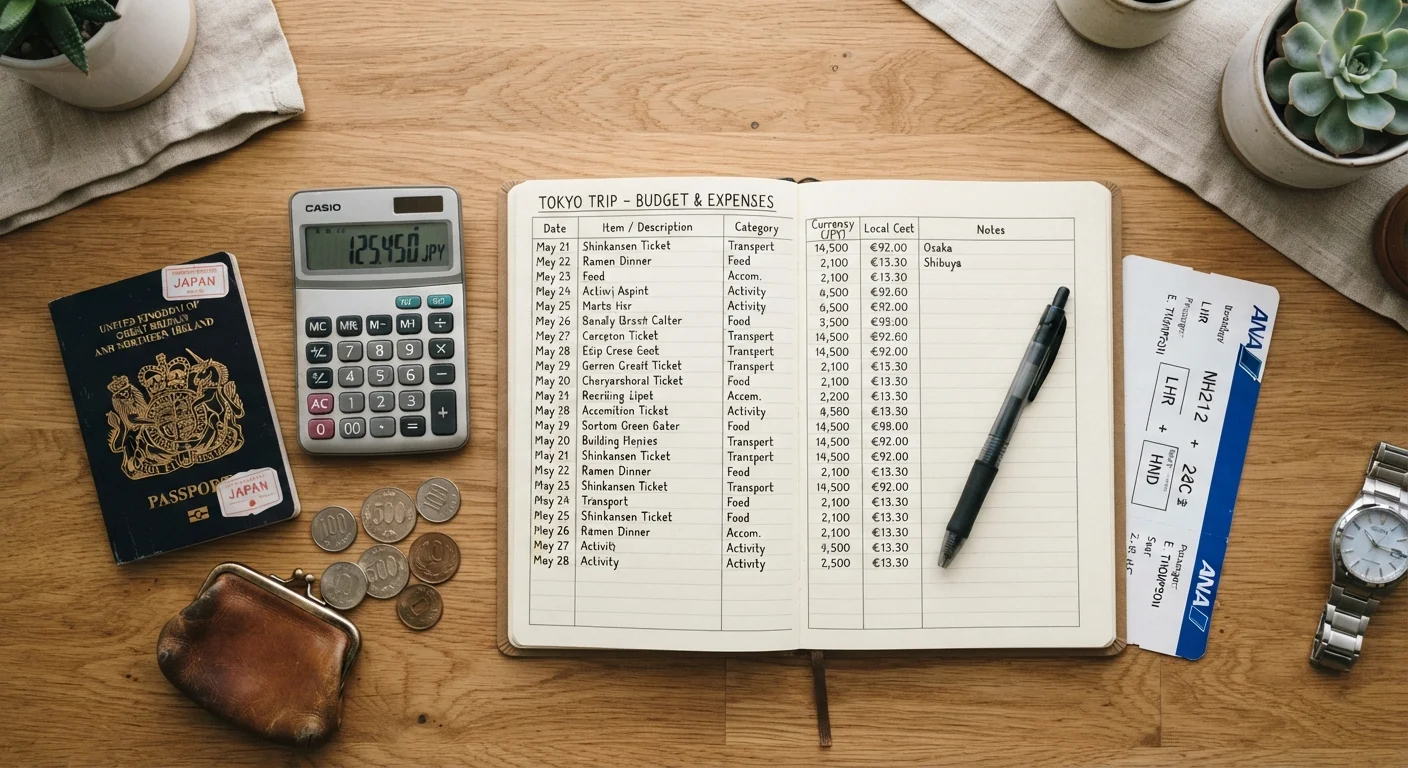
- Notebook method: Jot down each expense in a small travel notebook by category. Simple, offline, no battery required.
- Spreadsheet on your phone: A basic table with columns for date, category, and amount. Works well if you already have a trip spreadsheet for bookings.
- Budgeting apps: Several general-purpose personal finance apps allow manual expense entry by category. No single app is universally best — choose one you'll actually use consistently.
The habit matters more than the tool. A quick five-minute daily check-in — ideally before bed — shows you whether you're on track or trending over, while you still have time to adjust.
The Daily Check-In Habit
A brief daily expense review takes under five minutes and is the single most effective way to stay on budget. Log what you spent, compare it to your daily target, and note whether you need to adjust tomorrow. Travelers who review daily almost always finish trips closer to their plan than those who check weekly.
Adjusting Your Budget Mid-Trip
Even well-researched budgets drift. Knowing how to respond without panic is a core travel skill.
If you find you're overspending in one category, identify which. Food and activities are the most flexible — a few self-catered meals or a free walking tour instead of a paid excursion can restore balance quickly. Fixed costs like accommodation are harder to change once booked, which is why the buffer fund matters so much.
Conversely, if you're underspending — perhaps accommodation was cheaper than expected — you can consciously reallocate those savings to experiences you'd otherwise skip. A budget is a living document, not a rigid rule.
For ongoing guidance on managing travel money, currency, and payment decisions throughout your trip, the Travel Money hub offers topic-by-topic resources.
Never Spend Your Emergency Buffer on Extras
The contingency fund exists for genuine emergencies — a missed connection, a medical visit, a lost item — not for an impulse excursion or an extra night out. If you want more spending money for activities, build that into its own category during planning. Depleting your buffer leaves you financially exposed if something actually goes wrong.
Post-Trip Budget Review: What to Do When You're Back
The review step is the most skipped — and the most valuable for future trips. Within a week of returning, compare your actual spending against your pre-trip categories. Where were your estimates accurate? Where were they off, and why?
Common findings: flights were close, accommodation was underestimated, food was overestimated, and activity costs were a surprise. Documenting this takes 20 minutes and gives you a personalized baseline for every future trip to a similar destination.
Also reconcile any foreign currency and check that all card charges have posted correctly. Billing errors and duplicate charges occasionally appear in the days after travel and are easier to dispute promptly.
Over time, your post-trip notes become the best research tool you have — more accurate than any generic cost estimate because they reflect your actual travel style.
This article provides general financial information for travel planning purposes. It is not personalized financial advice. Costs and conditions vary widely by destination and change over time; always verify current prices and entry requirements with official sources before traveling.