Why Yellowstone's Thermal Features Demand Respect
Yellowstone National Park sits atop one of the world's largest active volcanic systems, and its roughly 10,000 hydrothermal features — geysers, hot springs, mud pots, and fumaroles — are a direct expression of that power. For first-time visitors, the visual drama is immediate: vivid colors, billowing steam, and the sound of water forcing through underground chambers create a scene unlike anything in everyday life.
That spectacle comes with genuine risk. Yellowstone's thermal waters have caused more burn injuries than any other hazard in the park, and several fatal incidents have occurred when visitors left designated trails. Understanding why these features are dangerous — not just that they are — is what allows you to visit with both confidence and safety. As you consider the full picture of destination safety, understanding what safety means in context is a useful starting point before any major trip.
Understanding the Hazards: Temperature, Acidity, and Thin Crust
Three physical properties make Yellowstone's thermal features uniquely dangerous, and each is invisible to the casual observer.
~10,000
Hydrothermal features in Yellowstone
According to the National Park Service, Yellowstone contains roughly half of the world's active geysers and tens of thousands of other thermal features.
200°F+
Temperature of many Yellowstone hot springs
At Yellowstone's elevation, water boils at approximately 199°F; many springs exceed this threshold, according to NPS geological data.
4M+
Annual visitors to Yellowstone
The National Park Service reports that Yellowstone regularly receives more than four million recreational visitors per year, with thermal basins among the most visited sites.
- Extreme temperature: Many hot springs exceed 200°F (93°C) — above the boiling point at Yellowstone's elevation. Contact with these waters causes severe burns almost instantly.
- Chemical composition: Some springs are highly acidic, others strongly alkaline. Both can cause rapid tissue damage on contact.
- Unstable ground crust: The colorful microbial mats surrounding hot springs form a deceptively solid-looking surface over thin, water-saturated ground. This crust can give way without warning, dropping a person directly into superheated water below.
These hazards compound each other. A person who breaks through unstable crust may fall into water that is simultaneously scalding and chemically aggressive. The National Park Service records injuries every season from visitors who assumed the ground was stable because it looked dry or firm.
Never Let Children Run Ahead on Boardwalks
Boardwalk sections in thermal basins do not have continuous railings, and hot springs border the path closely at many points. Young children should be kept by hand throughout any thermal basin walk. The ground immediately adjacent to boardwalks is not a safe surface to step onto, even momentarily.
What the Boardwalks and Signs Actually Mean
The wooden boardwalks throughout Yellowstone's thermal basins — Old Faithful, Midway Geyser Basin, Norris Geyser Basin, and others — are not merely a convenience. They are engineered to distribute weight across ground that would otherwise crack under a person's footfall. Stepping off a boardwalk, even briefly for a photograph, places you on ground the park has determined is unsafe to traverse on foot.
Photograph from the Boardwalk
You do not need to step off the boardwalk or approach a barrier to capture compelling images of thermal features. A standard smartphone camera at boardwalk level produces excellent results. Attempting to get closer for a better angle is the most common reason visitors end up in dangerous positions — and it rarely improves the photo.
Signs reading "Stay on Trail" or "Danger: Thin Crust" indicate that the National Park Service has assessed that specific ground as structurally unreliable. "Thermal Area: Do Not Touch" markers mean the water or ground temperature is high enough to cause immediate injury. These are not advisory suggestions — they reflect engineering and geological assessments.
Roped or fenced areas indicate zones where the ground is considered too unstable for boardwalk construction at all. These perimeters are set conservatively, and there is no safe way to determine by sight whether the ground just beyond a barrier is stable.
How to Visit Responsibly and What to Prioritize
Responsible visiting at Yellowstone's thermal areas is straightforward: stay on boardwalks and designated trails at all times, keep children within arm's reach, and keep pets out of thermal basins entirely (pets are prohibited on boardwalks park-wide). Do not attempt to collect water samples or touch any thermal feature.
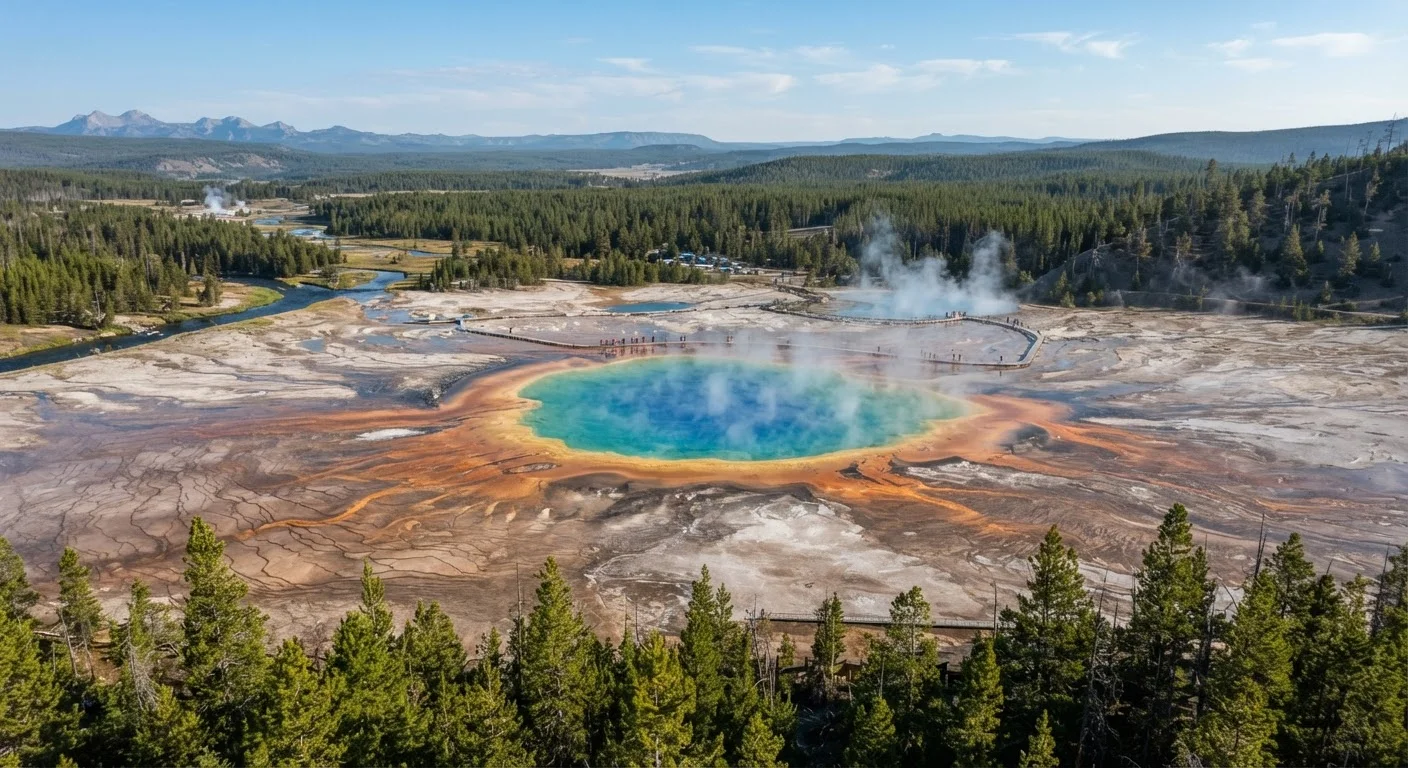
Read the color of a hot spring before approaching any barrier: deep blue at the center typically signals the hottest, most acidic water. The vivid orange and yellow edges are microbial mats — not solid ground.
The color gradient in Yellowstone's hot springs directly reflects temperature and chemical composition, giving informed visitors a visual cue about hazard intensity without requiring scientific equipment.
Download the NPS Yellowstone app before you arrive and check the geyser prediction feature — it can save you hours of waiting at Old Faithful and lets you plan the rest of your basin walk around eruption windows.
Rangers and seismographic data feed real-time geyser predictions into the app; visitors who use it consistently report a more efficient and satisfying experience than those who rely on posted signs alone.
The payoff for following these guidelines is complete. Every major thermal feature in the park — including the Grand Prismatic Spring, Old Faithful, and the travertine terraces at Mammoth Hot Springs — has well-positioned viewing platforms that provide unobstructed, close-range views. You do not need to leave the boardwalk to have an exceptional experience. For broader context on staying alert in unfamiliar environments, personal safety principles for first-time travelers apply here as much as anywhere.
Wildlife near thermal areas adds another consideration. Bison frequently rest on and near boardwalks. The NPS recommends maintaining at least 25 yards of distance from bison and 100 yards from bears and wolves. Do not approach any animal to shorten that gap, regardless of how calm it appears.
Planning Your Visit: Access, Timing, and Logistics
Most of Yellowstone's signature thermal basins are accessible year-round, though road closures affect interior routes from November through late April. The Upper Geyser Basin (home to Old Faithful) and Mammoth Hot Springs remain accessible in winter via snowcoach or snowmobile tour. Summer brings the largest crowds, with peak congestion typically from late June through mid-August.
Winter Access Is Possible but Requires Planning
During winter months, the interior of Yellowstone is accessible only via oversnow vehicles — snowcoaches and guided snowmobile tours. Private vehicles cannot access most roads from roughly November through late April. Verify current seasonal road status directly with the National Park Service, as opening and closing dates vary by year and weather conditions.
Arriving at thermal basins before 8 a.m. offers meaningfully thinner crowds and better steam visibility, as cooler morning air makes steam columns more photogenic. Geyser prediction times — posted at ranger stations and on the NPS app — let you time Old Faithful eruptions without long waits. The NPS Yellowstone app provides real-time road conditions, thermal area status, and wildlife sighting reports.
Thermal basin closures occur regularly due to new hydrothermal activity, ground disturbance, or trail damage. Always check the official NPS Yellowstone website or the park's visitor centers for current access conditions before driving to a specific area. Planning this way avoids the frustration — and the sunk cost — of arriving at a closed trailhead. If you've found Yellowstone's physical demands surprising, note that the Grand Canyon presents a similarly underestimated physical challenge for first-timers. Both parks reward preparation. For a comprehensive foundation on staying safe while traveling, reviewing core safety practices before any national park visit is time well spent.