How Zones Are Structured
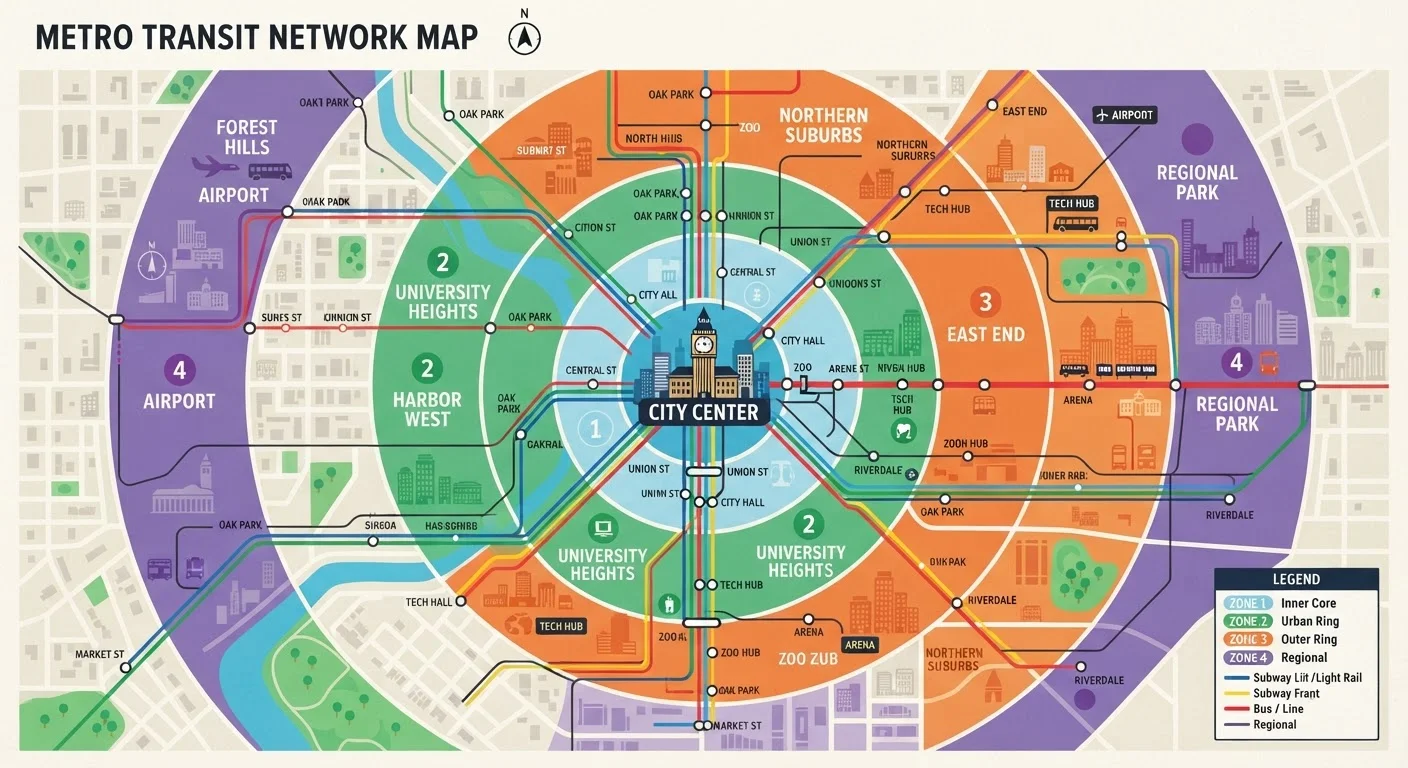
Picture a target. The bullseye is the city center — downtown, the main rail terminus, or wherever the transit authority considers the core. Around it, concentric rings mark Zone 2, Zone 3, and beyond. Some networks use numbers; others use letters or colors. The labels differ, but the logic is the same: zones radiate outward, and the further from the center you travel, the more zones you cross.
Not every zone map is perfectly circular, though. Geographic features like rivers, hills, or existing rail lines mean zones are often irregular polygons drawn around station clusters. What matters is that each station is assigned to exactly one zone, and that assignment determines which pricing bracket your journey falls into.
6
Fare zones in Transport for London's network
Transport for London operates one of the most referenced zone systems globally, with zones numbered 1 through 6 radiating from central London.
3x+
Price difference between inner and outer zone travel
On many large metropolitan networks, a journey spanning all fare zones can cost three or more times the price of a single inner-zone trip.
~50%
Of major global metro systems use zone-based fares
Roughly half of the world's large urban rail networks use some form of geographic zone pricing, according to transit industry overviews.
Some systems — London's Overground and Underground are a well-known example — also extend zone numbering far into suburban and exurban areas, meaning a commuter traveling from the outer suburbs may cross four or five zones on a single trip.
What You Actually Pay: The Zone Calculation
Your fare is calculated by counting how many zone boundaries your journey crosses, then applying the network's pricing table. A trip entirely within Zone 1 costs the minimum. A trip from Zone 1 to Zone 3 crosses two boundaries and costs more. The pricing doesn't have to be linear — many networks charge a steeper rate for the first zone crossed and smaller increments for each additional one.
This is why two trips of very different lengths can cost the same amount: a short trip that crosses a zone boundary may cost more than a longer trip that stays within one zone. First-time riders often find this counterintuitive, especially if they're used to taxis or ride-shares where distance drives price.
Plan Your Zones Before You Tap In
Before your first journey in any unfamiliar city, look up the zone number for both your starting station and your destination on the official transit map. Write them down or screenshot the map. Knowing you need a Zone 1–3 ticket in advance prevents scrambling at the ticket machine with a queue behind you.
To understand what payment methods are accepted on any zone-based network, see our guide on transit cards and contactless payment options.
Daily Caps, Passes, and Smart Strategies
Many modern zone-based networks build in spending caps. A daily cap means that once your tap-in/tap-out card charges accumulate to a set threshold for a given day, all further journeys in those zones become free for the rest of that day. Weekly caps work similarly. These protections are typically automatic on stored-value transit cards — you don't need to do anything special to activate them.
Tourist day passes often cover a fixed set of zones at a flat rate. If you're only visiting central attractions, an inner-zone pass may be sufficient and cost less. If you plan to visit an airport or an outlying neighborhood, check whether your pass extends that far before tapping in. You can plan zone requirements in advance using local transit apps that display fare estimates by zone.
Caps Are Card-Specific, Not Universal
Daily and weekly fare caps typically apply only to registered or named transit cards, not to anonymous stored-value cards or single-use paper tickets in many cities. Register your card with the transit authority — often free online — to make sure you benefit from any automatic cap that applies.
Common Mistakes and How to Avoid Them
The most frequent error first-time riders make is assuming their ticket or card covers any destination on the network. A card loaded for Zones 1–2 will be rejected — or result in a penalty — if your destination is in Zone 3. Always confirm your ticket's zone coverage before boarding, not after arriving.
A second mistake is neglecting to tap out. Zone-based systems that use tap-in/tap-out readers need both actions to calculate your fare accurately. Forgetting to tap out often triggers a maximum default charge, since the system assumes you traveled to the furthest zone on the line. If you tap in but forget to tap out, check whether the network has an app or customer service option to correct the charge. For more on why barriers sometimes refuse entry, see why your subway fare got rejected at the gate.