The Door Closes - Now What?
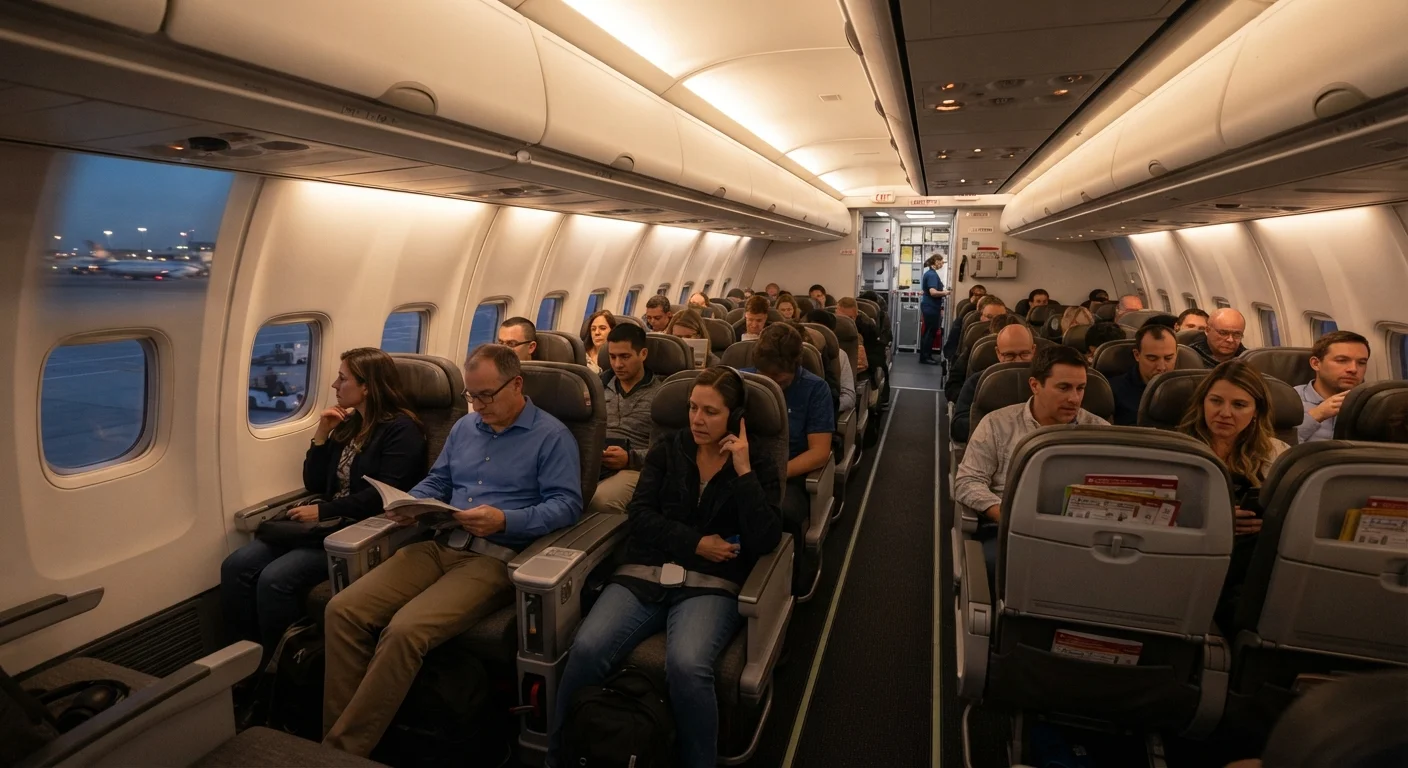
The moment the cabin door seals shut, the aircraft transitions from a boarding environment to an active operational one. Flight attendants begin arming the door slides - a process you may hear announced as "doors to automatic" - which means evacuation slides are now primed for emergency deployment. This is also when any passenger still without a seatbelt should fasten one.
Almost immediately, you'll notice the plane begin to move backward. This is pushback, and it's performed by a ground support vehicle called a tug or tow tractor attached to the nose gear. The aircraft's engines may already be running at low power, or they may start during or just after pushback. Either way, the backward motion is entirely expected - the plane is being guided away from the gate to a position where it can begin forward movement under its own power.
For a full picture of what to expect once you're onboard, see our step-by-step boarding-to-landing guide for first-time flyers.
Taxiing: Following an Invisible Road
Once pushback is complete and the tug disconnects, the pilots begin taxiing - driving the aircraft along marked pathways on the airfield called taxiways. These routes are painted on the ground and lit with colored lights, and the specific path your aircraft takes is assigned by ground control, a dedicated radio frequency separate from the main control tower.
Inside the cockpit, pilots are cross-checking their taxi route against airport charts and confirming runway assignment. In the cabin, flight attendants conduct the safety demonstration during this time. Even if you've heard it before, paying attention matters - exits and brace positions can vary by aircraft type.
Use Taxiing Time Productively
Rather than tensing up during the taxi phase, use it to get oriented. Locate the exits nearest to your seat, confirm your seatbelt is correctly fastened, and stow anything you won't need until cruising altitude. By the time the plane lines up on the runway, you'll feel settled and prepared.
Taxiing can feel bumpy because airport taxiways, unlike runways, are not always perfectly smooth. Some surface irregularity is normal. You may also hear mechanical sounds as the crew configures the flaps (control surfaces on the wings) for takeoff - this is routine. To decode other sounds you'll encounter during flight, check out what every announcement, bell, and light on a plane actually means.
The Runway Queue and Final Clearance
As your aircraft approaches the active runway, it will typically join a sequence of other planes waiting to depart. This is called the departure queue, and it's managed entirely by air traffic control. The tower assigns each aircraft a specific departure slot, spacing them to ensure safe separation in the air.
You may sit at a holding point just short of the runway for several minutes. When your aircraft is cleared, it will taxi onto the runway, align with the centerline, and pause briefly while the crew receives final takeoff clearance. This moment - engines spooling up, the aircraft motionless on the runway - is the last beat of the pre-takeoff phase.
~18 min
Average taxi-out time at major U.S. airports
According to U.S. Bureau of Transportation Statistics data, average taxi-out time at large hub airports has historically hovered around 16-20 minutes under normal conditions.
30-40%
Share of flight delays attributed to ground operations
Industry analyses consistently show that a significant portion of departure delays originate during ground handling and taxi phases rather than in the air.
At large hub airports, total taxi times can range from 10 minutes to over 40 minutes depending on the time of day and runway configuration. A longer-than-expected wait is nearly always a sequencing matter, not a mechanical one. First-time flyers often note that this waiting period feels more manageable once you understand what's happening outside the window.
What You Should (and Shouldn't) Do During This Phase
The pre-takeoff phase has a few firm expectations for passengers. Your seatbelt should remain fastened and visible over any blanket or jacket - flight attendants will check. Seat backs and tray tables must be upright and stowed, and carry-on bags secured in the overhead bin or fully under the seat in front of you. These aren't arbitrary rules; they reduce obstacles during an emergency evacuation.
Window shades are typically asked to remain open during takeoff and landing. This allows crew and passengers to assess conditions outside quickly if something unexpected happens. Phones should be in airplane mode per the crew's instructions - follow whatever guidance your specific flight gives you.
If anything feels unfamiliar or confusing during this phase, the Airport Know-How hub has resources that walk through the broader airport and boarding experience from the ground up.
This article provides general information about standard commercial aviation procedures. Individual airlines, aircraft types, and airports may vary. Always follow the instructions of your specific flight crew.