
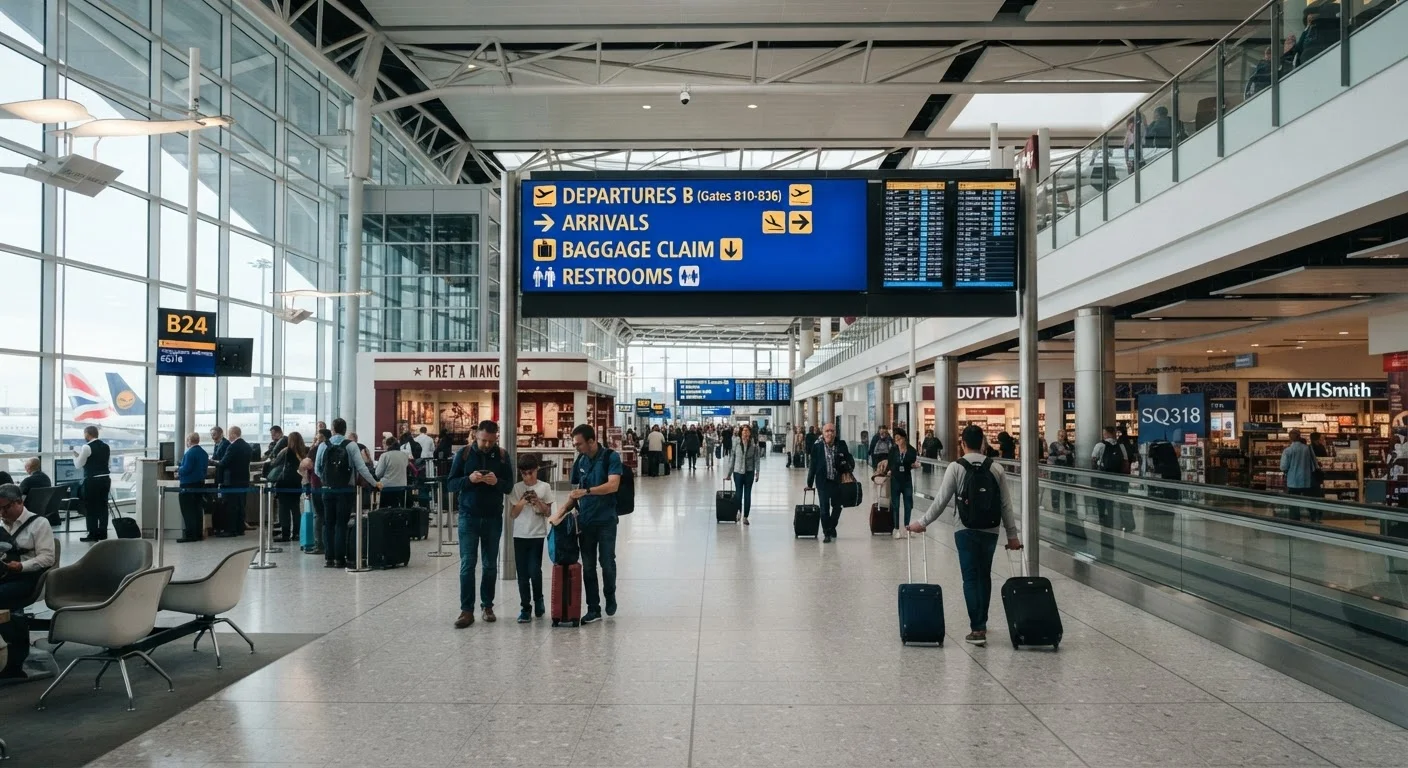
Why Airport Signs Look the Way They Do
Airport signage isn't random - it follows an internationally recognized system designed so that travelers can navigate successfully even when they don't speak the local language. Most large airports worldwide draw from the same library of pictograms developed and refined by aviation and design organizations over decades. The goal is instant recognition: a silhouette of a suitcase on a conveyor belt means baggage claim whether you're in Atlanta or Amsterdam.
Color coding does a lot of the heavy lifting. In most U.S. airports, yellow or black signs point to ground transportation and the exit; blue signs often indicate facilities and services like restrooms or information desks; green signs guide you toward gates and departures. Individual airports may vary slightly, so always cross-reference the color with the icon and text.
If you want a broader orientation before your trip, read our walkthrough of the full airport journey - it pairs naturally with this visual reference.
| Primary navigation colors (U.S. airports) | Yellow/black for exits; blue for services; green for gates (Common convention; verify at your specific airport) |
| International pictogram standard | ISO 7010 and AIGA symbol system widely adopted (International Organization for Standardization) |
| Information desk symbol | Lowercase 'i' on blue background (Universal facility signage convention) |
| Emergency exit symbol color | Green (ISO standard); red in some countries (ISO 7010 E001) |
| Baggage claim locator | Flight number displayed on screen above each carousel (Standard practice at most commercial airports) |
The Most Important Signs, Decoded
Below are the sign categories you are most likely to encounter, grouped by the stage of your journey.
Before Security
- Check-In / Ticketing - Usually shown with a person at a desk or a ticket icon. Follow these from the terminal entrance to reach airline counters or self-service kiosks.
- Baggage Drop - A suitcase icon, sometimes with a downward arrow. Used when you've already checked in online and only need to hand over luggage.
- Security Checkpoint - Often a shield or an archway symbol. This is where TSA or equivalent screening takes place. Understanding what screeners are looking for can help you prepare your bag correctly.
Airside (After Security)
- Gate Numbers - Alphanumeric codes like B12 or C4. Arrows beneath them indicate direction. Learn the difference between a terminal, concourse, and gate so these codes make intuitive sense.
- Connecting Flights / Transfers - A plane with a curved arrow or two intersecting arrows. Follow these if you are catching a second flight at the same airport.
- Duty-Free / Shops - A shopping bag icon, sometimes with a star or price tag symbol.
On Arrival
- Baggage Claim - A conveyor belt with a suitcase. Multiple carousels are numbered; your flight number appears on a screen above the correct carousel.
- Customs / Border Control - A passport with a stamp icon, or the word CUSTOMS in high-contrast text. Separate lanes may be marked for nationals and visitors.
- Ground Transportation - A bus, taxi, or car icon, usually pointing toward exits. Familiarize yourself with transfer terminology before you reach this point.
Airside
The area of an airport that is beyond the security checkpoint. Only passengers with valid boarding passes can access airside areas, which include departure gates, duty-free shops, and some lounges.
Landside
The publicly accessible part of an airport before the security checkpoint. Check-in desks, ticketing counters, and general arrivals halls are typically landside.
Pictogram
A standardized graphic symbol designed to communicate information quickly and without relying on language. Airport signs use pictograms so travelers of any nationality can navigate.
Baggage Carousel
The conveyor belt system in the baggage claim area where checked luggage is delivered after a flight. Each carousel is assigned a number or letter corresponding to a specific flight or set of flights.
Connecting Flight
A second (or subsequent) flight taken as part of the same journey, requiring the passenger to transfer from one aircraft to another, sometimes in the same terminal and sometimes in a different one.
Duty-Free Zone
A retail area in international airports, usually located airside, where goods are sold without certain local or national taxes. Purchases are typically subject to customs limits on arrival.
Accessibility, Emergency, and Facility Symbols
Beyond navigation, airports use a second tier of symbols that relate to safety and services.
- Accessibility symbol - The familiar blue wheelchair figure indicates accessible routes, elevators, and adapted facilities. Look for it if you or someone in your group needs step-free access.
- Emergency Exit (Running Figure) - A green figure running toward a door. These signs are illuminated and mark evacuation routes. Note their positions when you arrive - not just during boarding.
- First Aid / Medical - A white cross on a green background, or a red cross depending on the country. Airport medical stations are typically located airside and before security.
- Restrooms - Silhouettes of figures in gender-coded or gender-neutral configurations. Family restrooms are indicated by an adult and child figure together.
- Information Desk - A lowercase letter i inside a circle, usually on a blue background. Staff at these desks can reprint boarding passes, answer layout questions, and assist if you feel lost.
Signs Can Vary Between Airports
While most airports follow broadly similar conventions, individual airports - especially smaller regional ones - may use non-standard colors or icons. It is always worth downloading your specific airport's map before you travel; most publish these on their official websites. If you feel disoriented after landing, stopping at the nearest information desk will quickly get you back on track.
When in doubt, the information desk - marked by that lowercase i - is always a safe first stop. Airport staff are trained to assist confused travelers quickly and without judgment.