
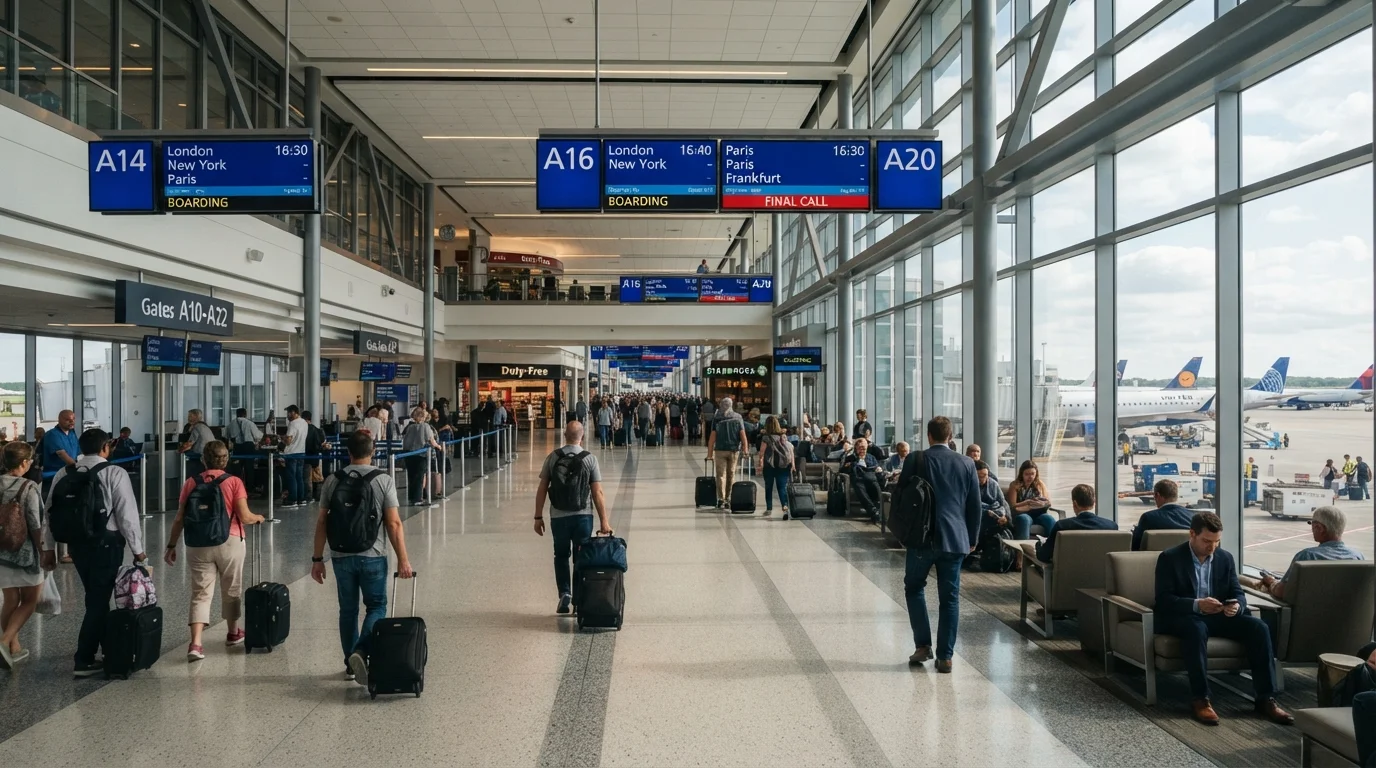
Why Airport Layout Confuses First-Time Travelers
When you look at your boarding pass for the first time, you'll see a gate printed on it - something like B22 or D5. What you won't see is a map explaining what those letters and numbers actually mean. Airport employees and frequent flyers use terms like terminal, concourse, and gate interchangeably in conversation, which only adds to the confusion.
These three words describe three different levels of airport geography - each one smaller and more specific than the last. Understanding how they nest together helps you read signs, plan your walking time, and arrive at the right door without second-guessing yourself. For help reading the signage once you're inside, see our guide to airport signs and symbols.
| Largest U.S. airport by terminals | John F. Kennedy International (JFK) - 6 terminals (Port Authority of New York and New Jersey) |
| Typical gate label format | Letter + Number (e.g., A14, C3) |
| Where to find your gate | Printed on your boarding pass; always verify on airport monitors |
| Inter-terminal transit | Often via shuttle bus, automated people mover, or connecting walkway |
Terminal, Concourse, Gate: The Three Levels Explained
Think of airport geography like a building inside a campus inside a city:
Terminal
A self-contained building at an airport where passengers check in, go through security, and access departure gates. Large airports may have multiple terminals, sometimes requiring a shuttle or train to travel between them.
Concourse
A corridor or wing within a terminal that groups a set of gates together. Think of it as a hallway branching off the main terminal building, labeled with a letter like Concourse A or Concourse B.
Gate
The specific numbered door where passengers board their aircraft. Your boarding pass will always show a gate number, such as B12 or C4, indicating both the concourse (B or C) and the door number.
Airside
The secure area of an airport that passengers can only access after passing through a security checkpoint. All gates and concourses are located airside.
Landside
The publicly accessible part of an airport before the security checkpoint. This includes ticketing counters, baggage claim, and ground transportation areas.
Gate Change
When an airline reassigns a flight to a different door than originally listed. Gate changes are common and are announced on airport monitors and sometimes via airline apps.
Terminal: The Building You Enter
A terminal is the main airport building - or one of several separate buildings - where your airport experience begins. It's where you check in your luggage, pass through the TSA security checkpoint, and gain access to the rest of the airport. At small airports, there's usually just one terminal. At major hubs, there may be several, and they are often not connected internally. If your connecting flight departs from a different terminal, you may need to exit security, take a shuttle or train, and re-enter through another checkpoint. Always check whether your connection requires a terminal change.
Concourse: The Wing Within the Terminal
Inside a terminal, you'll find concourses - long corridors or wings that branch off the main building, each identified by a letter (A, B, C, and so on). A concourse groups a cluster of gates together. When you see a sign pointing to Concourse B, you're being directed down a specific hallway where gates B1 through B30 (or however many exist) are located. Not all terminals use the concourse system; some smaller terminals simply number their gates sequentially without a letter prefix.
Gate: The Specific Door to Your Plane
A gate is the individual numbered door at the end of a jetway - the enclosed walkway that connects the terminal to the aircraft. Your boarding pass will always show a gate designation. The letter tells you which concourse to walk to; the number tells you which door within that concourse. Gate B22 means: go to Concourse B, find door number 22. Once you reach your gate, you'll find seating, a gate agent desk, and boarding information displayed on a screen above the door.
Gate Changes Happen - Check the Monitors
Airlines frequently reassign gates due to aircraft swaps, delays, or congestion. Your boarding pass may show one gate, but the actual departure gate can change right up until boarding. Always check the departure monitors inside the airport and, if your airline offers one, the mobile app for real-time updates. Never head straight to the printed gate without confirming it on a screen.
How to Use This Knowledge on Travel Day
Knowing these definitions is most useful when you're navigating a busy airport under time pressure. Here's how to apply them:
- Read your boarding pass before you land or arrive. Note the terminal, concourse, and gate number. If you're connecting from another city, your boarding pass for the second flight will show where you need to go next.
- Check the departure monitors immediately upon entering the airport. Monitors near the entrance show all departing flights sorted by airline or destination. Confirm your gate before heading to security.
- Budget extra time if you need to change terminals. Inter-terminal connections via shuttle, train, or walking bridge can take 15-25 minutes - not counting security lines if you need to re-clear.
- Follow concourse signs once you're airside. After security, look for overhead signs directing you to your concourse letter. Our airport signage guide explains what each symbol means.
- Recheck your gate at the concourse entrance. Gate changes are common. Verify the monitor near your concourse entry matches your boarding pass before committing to a long walk.
If you're still working out how to get from the airport to your hotel or destination after you land, the guide to airport transfer options walks through your choices clearly. And if unfamiliar travel terms are slowing you down, key travel planning terms is a helpful quick reference.
75+
Gates at major U.S. hub airports
Large hubs like Chicago O'Hare and Dallas/Fort Worth operate dozens of gates spread across multiple terminals and concourses.
~20 min
Typical inter-terminal transit time
Traveling between terminals at large airports via shuttle or train can take 15-25 minutes; always factor this into connections.