
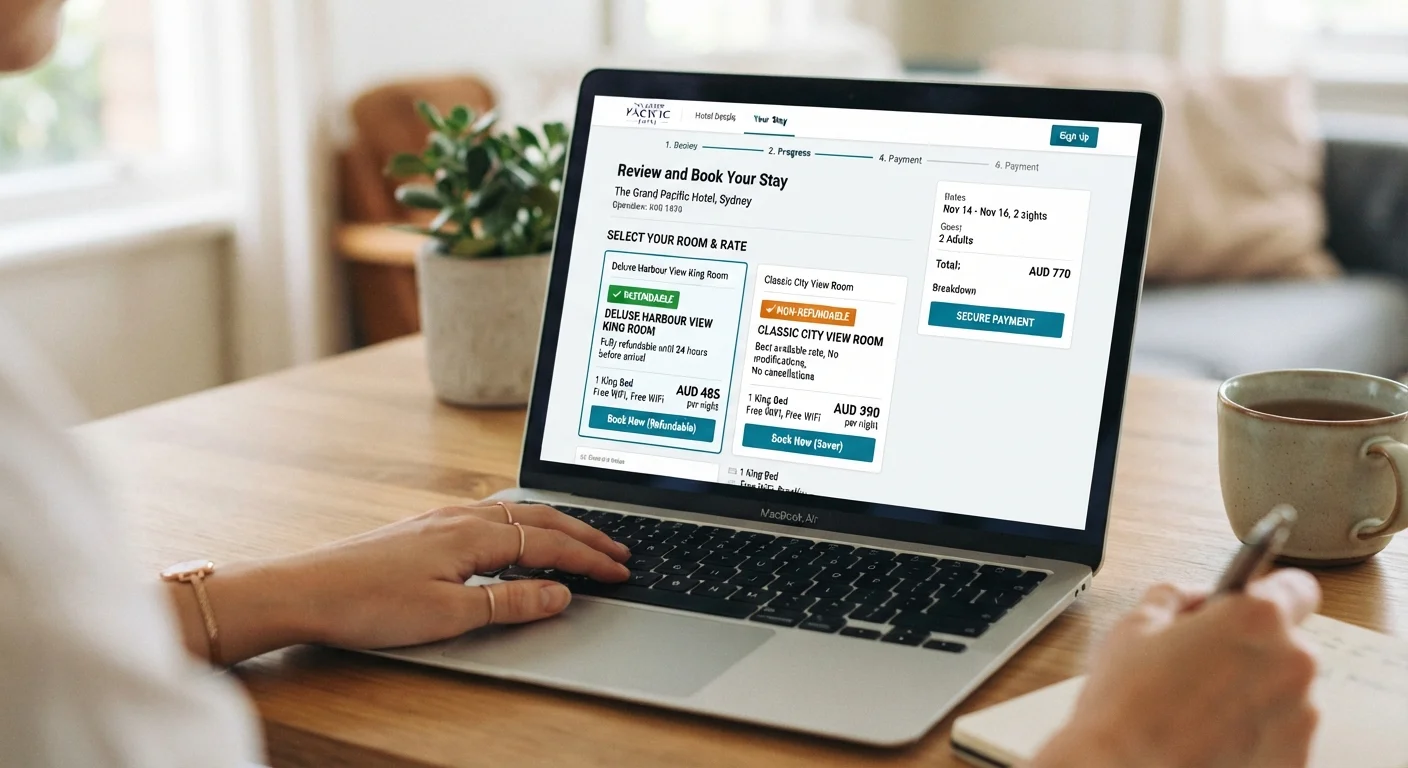
What These Rate Types Actually Mean
When you search for a hotel room, you'll almost always see at least two pricing options for the same room. One promises free cancellation; the other shows a lower price with no refund. Understanding what each commitment involves is one of the most practical skills a first-time traveler can develop.
Refundable rates (also called flexible rates) allow you to cancel your reservation up to a specified deadline — often 24 to 72 hours before check-in — and receive a full refund. If you cancel inside that window, you may owe a penalty, sometimes one night's stay. Always locate the exact cutoff time in the rate details, not just the label.
Non-refundable rates charge your payment method at the time of booking, and that charge is final regardless of what happens afterward. If you cancel, change dates, or simply don't show up, the hotel keeps the full amount. In exchange, non-refundable rates are typically priced noticeably lower than their flexible counterparts.
Neither option is inherently wrong. The right choice depends entirely on how certain your travel plans are and how much financial risk you're comfortable absorbing. See our guide to cancellation policies for a deeper look at what the fine print in these agreements actually means.
| Criterion | Refundable Rate | Non-Refundable Rate |
|---|---|---|
| Typical price | Higher nightly rate | Lower nightly rate |
| Cancel before deadline | Full refund issued | No refund — charge is final |
| Cancel after deadline | Penalty (often one night) | Full charge retained |
| When payment is charged | Often at check-in (varies) | Usually at time of booking |
| Best scenario | Uncertain or flexible plans | Confirmed, unchangeable plans |
| Risk level | Low — cancellation is an option | High — no safety net if plans shift |
How to Decide Which Rate Fits Your Trip
Start by honestly assessing how firm your plans are. Ask yourself: Could a work deadline, health issue, or family obligation realistically force you to cancel? If any of those feel plausible, the price gap between rate types is essentially an insurance premium — and the refundable rate is usually the smarter spend.
Next, consider your booking timeline. If you're reserving a room several months out, a lot can change before your arrival date. Locking in a non-refundable rate that far in advance increases your exposure. Many experienced travelers book refundable rates early and switch to a non-refundable rate only once their plans solidify closer to the trip — sometimes finding a better price in the process.
Also think about how you're booking. Third-party travel sites sometimes layer their own cancellation terms on top of the hotel's policy, which can complicate refunds. Booking directly with the hotel often provides cleaner, more transparent cancellation terms. For a full breakdown of how booking channel affects your flexibility, see how direct vs. third-party bookings differ.
~10–25%
Typical discount for non-refundable rates
Hotels commonly price non-refundable rooms 10–25% below their flexible-rate equivalent, though the exact gap varies by property and market.
48–72 hrs
Most common free-cancellation window
Many hotel cancellation policies require notice 48 to 72 hours before check-in to qualify for a penalty-free cancellation.
Finally, factor in travel insurance. A comprehensive trip cancellation policy may reimburse non-refundable hotel costs if you cancel for a covered reason — such as sudden illness or a family emergency. However, policies vary significantly in what qualifies as a covered reason, so review the terms of any policy carefully before assuming it protects your booking.
Red Flags and Common Mistakes to Avoid
First-time travelers most often stumble in three areas when choosing between these rate types.
- Skimming the cancellation deadline: A rate labeled "free cancellation" is only free if you cancel before the stated cutoff. Many travelers assume they have until check-in day, but the deadline is frequently 48 to 72 hours earlier. Mark the cancellation deadline in your calendar immediately after booking.
- Choosing non-refundable to save a small amount: If the price difference between rate types is $10 to $20 per night, ask whether that savings justifies losing the entire stay's cost if plans change. For short trips, the math often favors flexibility.
- Assuming refundable means no charge today: Some refundable rates still charge your card at booking and issue a refund upon cancellation. Others charge nothing until check-in. Read the payment terms alongside the cancellation terms — they're separate details.
Understanding how hotel rates interact with your broader travel budget is equally valuable. Our article on fixed vs. variable travel costs explains how locked-in expenses like non-refundable bookings fit into a realistic trip budget. And if you've ever wondered what the nightly rate doesn't include, reading a hotel room rate walks through the taxes and fees that get added at checkout.
Airline Rates Work Similarly — But Differently
The refundable vs. non-refundable distinction also applies to airline tickets, but the rules, penalties, and definitions differ meaningfully from hotel policies. What counts as 'refundable' on a flight can involve fare classes, change fees, and credit vouchers rather than straightforward cash refunds. See our guide to flexible airline tickets to understand how those terms translate in practice.