Why DC Rewards a Structured Approach
Washington D.C. is one of the most visitor-friendly capital cities in the world on paper — free museums, a walkable grid, and an efficient Metro system. In practice, first-time visitors frequently leave feeling they've seen less than they planned because the scale of the Mall and the sheer number of options create decision paralysis on arrival.
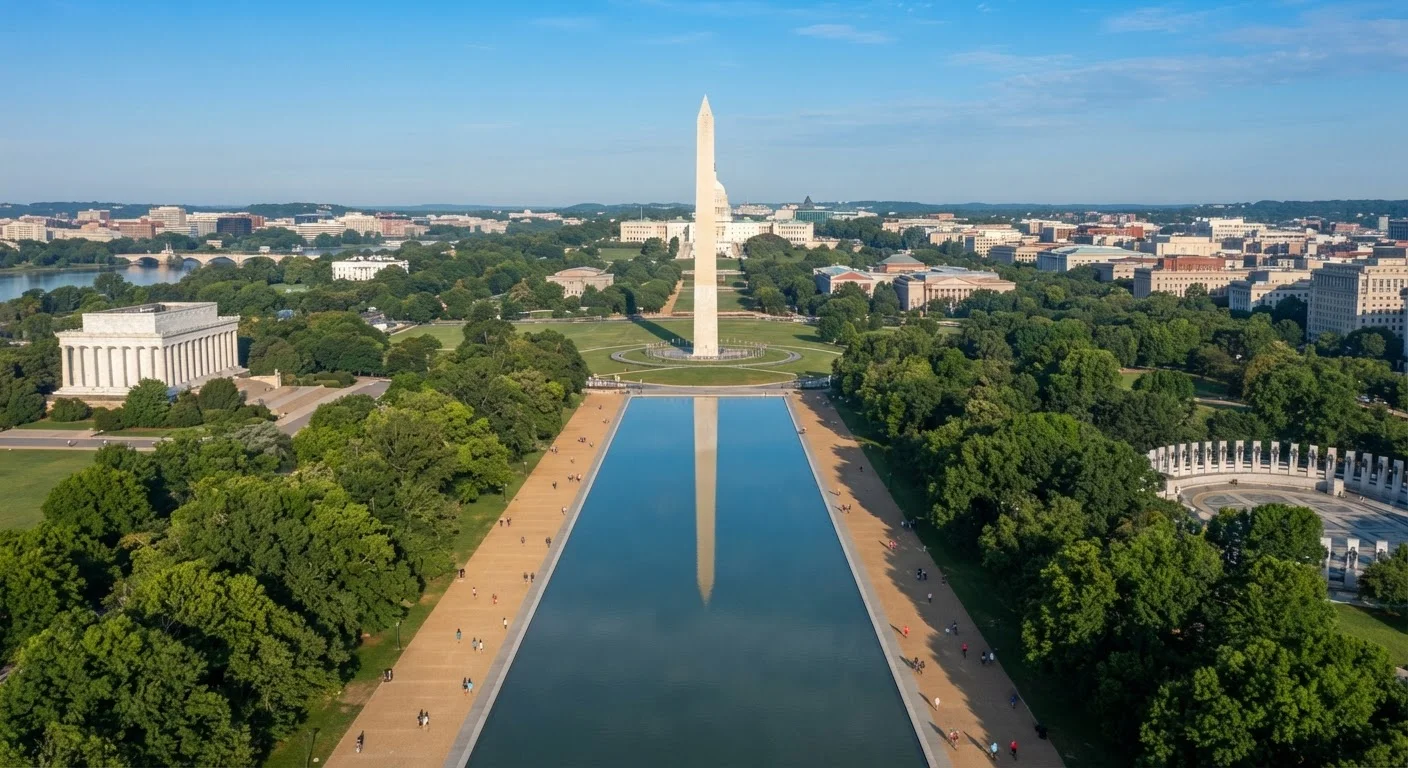
The city's layout is genuinely logical once you understand it. The National Mall functions as the city's civic core, with the Capitol anchoring the east end, the Lincoln Memorial the west, and the Washington Monument at the center. Radiating outward from this axis are distinct neighborhoods — each with its own character and its own transit access point — that reward deliberate exploration rather than accidental discovery.
The framework below treats a weekend (two full days) as the baseline. It prioritizes free, high-value experiences, accounts for the advance reservation requirements that catch many first-timers off guard, and structures movement by geography rather than by category. DC is very different from a city like New York, where density rewards spontaneity — for a comparison of the two cities' first-timer dynamics, see what to expect before arriving in NYC.
What you will need
What You'll Need Before You Start
A successful DC weekend depends heavily on preparation done before you arrive. The city's most iconic sites operate on federal timetables with limited walk-up capacity. Unlike a typical city trip where spontaneity is an asset, DC punishes late planning — particularly for monument access.
Washington Metropolitan Area Transit Authority (WMATA) Metro
DC's rapid transit system connects every major tourist corridor and eliminates the need for a rental car within the city.
Recreation.gov / Official Agency Pass Portals
Used to reserve free timed-entry passes for the Washington Monument and other federally managed sites.
National Mall & Memorial Parks Map (NPS)
The National Park Service's official printed and digital map helps you orient monuments relative to Metro exits.
Capital Bikeshare
Short-term bike rentals stationed across the city offer a fast, low-cost option for covering the length of the Mall.
Reserve Passes Before You Arrive
Several of DC's most visited sites — including the U.S. Capitol, the Washington Monument, and the National Archives — require free timed-entry passes that must be reserved in advance. These passes routinely fill weeks ahead of peak travel periods. Check the official government or agency website for each site and book your passes as early as possible to avoid missing out on marquee stops.
Accommodation choice also affects how much time you lose each day. Staying within walking distance of a Metro station on the Blue, Orange, or Silver lines is the single most practical logistical decision you can make. These lines run through the heart of the tourism corridor and connect directly to Reagan National Airport, which is the most convenient arrival point for most domestic travelers.
The Step-by-Step Weekend Framework
Follow these steps in sequence to structure both days efficiently. The framework is intentionally lean — it leaves room for the inevitable detour or extended conversation with a museum exhibit that earns its time.
Wear Comfortable Walking Shoes
The National Mall stretches nearly two miles from the Capitol to the Lincoln Memorial. First-time visitors frequently underestimate how much ground they'll cover on foot. Inadequate footwear is one of the most common — and most avoidable — reasons a DC trip turns uncomfortable by day two.
Anchor your itinerary around the National Mall on Saturday morning
The National Mall is DC's central spine, and Saturday morning is the single best window to visit. Federal offices are closed, foot traffic is lighter than midday, and the light from the east makes the Reflecting Pool particularly striking before 9 a.m. Start at the Lincoln Memorial end and walk east toward the Capitol, stopping at the Vietnam Veterans Memorial, the Korean War Veterans Memorial, and the World War II Memorial along the route.
Allocate roughly 90 minutes for this corridor. Do not attempt to visit every memorial in detail — read them selectively and move with purpose. Trying to do everything leads to the fatigue that ruins afternoon plans. See how to structure a one-day plan for a framework you can apply directly to this morning block.
Choose one Smithsonian museum for a focused midday visit
With 17 free Smithsonian museums on or near the Mall, the instinct is to visit several. Resist it. A single museum explored thoroughly is far more rewarding than five museums skimmed in 20 minutes each. First-time visitors with broad interests tend to get the most from the National Museum of American History or the National Museum of Natural History, both of which have well-organized permanent collections suited to a 90-minute visit.
Those with specific interests — aerospace, African American history, art — should select accordingly. Arrive just after the museum opens (typically 10 a.m.) to avoid the midday crowd peak, which usually hits between 11:30 a.m. and 1:30 p.m.
Use the Metro to reach a secondary neighborhood in the afternoon
After the Mall, take the Metro to a distinct neighborhood rather than continuing to walk. Capitol Hill, Georgetown, and Dupont Circle each offer a different character — historic rowhouses and independent restaurants on the Hill, a walkable commercial waterfront in Georgetown, and a dense urban grid in Dupont. Pick one and spend 2–3 hours there.
Georgetown is not served directly by Metro; take the Blue or Orange Line to Foggy Bottom–GWU and walk approximately 15 minutes north, or use a bikeshare station near the station exit. For a broader strategy on managing transit in unfamiliar cities, consult our public transport walkthrough.
Use Sunday for your timed-entry reservation and one anchor institution
Reserve Sunday for whichever timed-entry site you've booked — the Washington Monument, U.S. Capitol Visitor Center, or National Archives. These visits are non-negotiable anchors: arrive 10 minutes before your entry window and bring a government-issued ID where required (the Capitol tour and National Archives both ask for identification).
Pair your timed-entry visit with one adjacent attraction that requires no reservation. The Library of Congress Great Hall is a five-minute walk from the Capitol and requires no pass. The National Gallery of Art sits directly on the Mall adjacent to the Archives.
Build in buffer time and avoid over-scheduling the second afternoon
Over-scheduling is the most common planning error for short city trips. Leave your final afternoon with no more than one soft commitment — a neighborhood walk, a specific restaurant, or a return to a site you didn't finish. This buffer absorbs delays and gives the trip room to breathe.
If you're already thinking about how to apply this framework to a longer itinerary, our day-by-day trip planning guide offers a complete method for structuring multi-day travel. And if DC is part of a broader Northeast trip that includes New York, review what first-timers should know about NYC before you go — the two cities operate very differently.
Use the Metro's Blue, Orange, and Silver Lines
These three Metro lines serve the core tourism corridor — from Reagan National Airport through Capitol Hill and into Georgetown-adjacent stops. Loading a SmarTrip card at any station kiosk on arrival is faster and cheaper than paying per-trip fares. For a full breakdown of navigating transit in an unfamiliar city, see our end-to-end transit guide.
Common Mistakes First-Time DC Visitors Make
Beyond over-scheduling, a few recurring errors consistently undermine short DC trips. The first is treating the Metro as a last resort. Visitors who default to rideshares or walking across the full length of the Mall lose 60–90 minutes per day unnecessarily. The Metro is fast, inexpensive, and stress-free for the core tourist routes.
The second error is ignoring neighborhood variation. DC has a reputation as a monuments-and-museums city, but neighborhoods like H Street NE, Shaw, and the Navy Yard have developed distinct food and cultural scenes that give the city texture beyond its federal core. Even a two-hour afternoon in one of these areas changes the tenor of the trip.
The third — and most financially painful — error is booking accommodation without checking proximity to transit. A hotel that appears close to the Mall on a map may require a 25-minute rideshare each way if it's not near a Metro line. Over a weekend, that adds up in both cost and time. If you're planning a broader trip that connects multiple cities, our guide to multi-city trip structure addresses how to prevent exhaustion from accumulating across stops.