
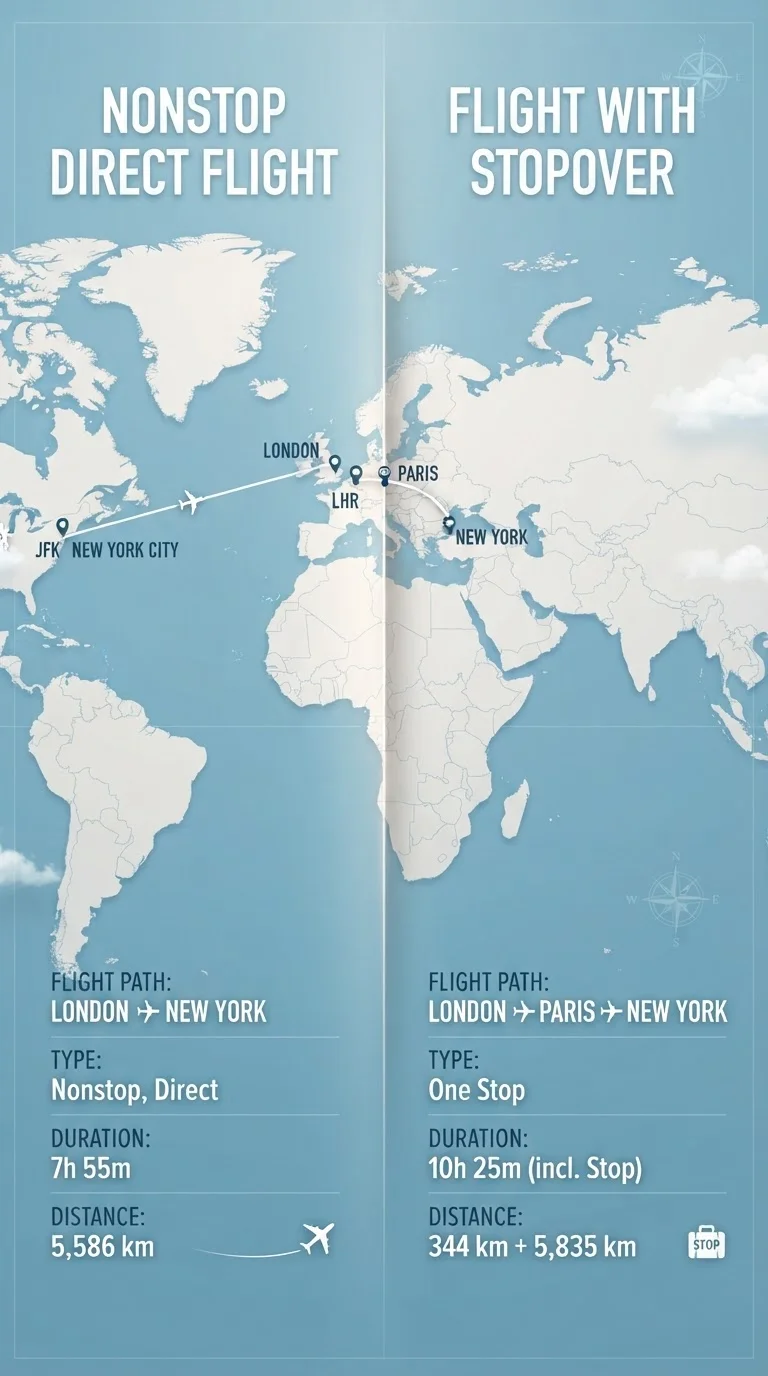
What Each Flight Type Actually Means
The terms are sometimes used loosely, so it helps to be precise. A nonstop flight takes off from your origin and lands at your destination without stopping anywhere in between. A direct flight, despite its name, may actually make one or more intermediate stops - though passengers typically stay on the same plane. Always check the flight details when booking to confirm whether you'll actually stay airborne the whole way.
A connecting flight requires you to land at an intermediate airport, disembark, and board a separate flight to reach your final destination. That middle point is called a layover. The two legs of the journey may be on the same airline or on partner airlines depending on how the ticket is booked. Understanding the difference matters because it affects your time, your luggage, and your stress level.
When comparing itineraries, look for the number of stops listed in the search results - "0 stops" means nonstop, while "1 stop" or more indicates a connection. See our guide to booking methods for tips on reading flight search results clearly before you commit.
Comparing the Key Trade-Offs
Neither option is universally better - each comes with a distinct set of advantages and drawbacks. The table below breaks down the most important factors side by side.
| Criterion | Direct (Nonstop) Flight | Connecting Flight |
|---|---|---|
| Total travel time | Shorter - no layover added | Longer - layover time included |
| Typical fare | Generally higher | Often lower |
| Disruption risk | Lower - one flight to manage | Higher - two or more flights |
| Baggage handling | Checked through automatically | May need re-checking if separate bookings |
| Airport navigation required | One airport only | Two or more airports |
| Route availability | Limited to high-demand routes | Available to almost any destination |
| Stress level for beginners | Lower - simpler process | Higher - more variables to manage |
One factor that surprises many first-time travelers is the checked baggage process on connecting flights. If you're on a single itinerary (one booking), your bags are usually checked through to your final destination. But if your two flights are booked separately, you may need to collect your luggage at the connection point and re-check it - which takes time and can cause you to miss your next flight if your first leg arrives late.
~30%
Typical fare difference on connecting vs. nonstop routes
Industry analysts broadly estimate connecting itineraries can run 20-40% less than nonstop equivalents on comparable routes, though this varies widely by airline and market.
60-90 min
Minimum recommended domestic connection time
Most major U.S. airlines and travel advisors suggest at least 60-90 minutes for domestic connections; international connections typically require more time due to customs and immigration.
When a Layover Adds Real Risk
The most stressful scenario in connecting travel is a tight connection: landing at one gate and needing to reach another gate in a large, unfamiliar airport within a narrow window of time. Many airports recommend at least 60-90 minutes between flights for domestic connections and longer for international ones, particularly if customs or immigration is involved.
If your first flight arrives late, the airline may rebook you on the next available flight - but this can mean hours of waiting, especially on busy routes. Weather, air traffic delays, and mechanical issues are all factors outside your control. For a deeper look at how connections work and what to do when time is short, see our full guide to layovers and tight connections.
International Connections and Entry Requirements
If your connecting flight crosses an international border - even briefly - you may be required to clear customs and immigration at the connecting airport, collect your bags, and re-check them before your next flight. This process can take 60-120 minutes or more. Always verify the entry and transit requirements for your specific itinerary with the relevant government and airline sources before booking, as rules vary by country and citizenship.
It's also worth checking whether your connecting airport requires re-clearing security. This is common when connecting between international and domestic flights, and it adds meaningful time to your layover. Verify the specific requirements for your route before booking.
How to Make the Right Choice for Your Trip
Start by asking yourself three practical questions: How much time do I have? How important is cost versus convenience? And how comfortable am I navigating an unfamiliar airport under time pressure?
If your origin city has limited nonstop options, a connection may be your only realistic path to certain destinations. Use that constraint as a starting point, then look at layover lengths and the reputation of the connecting airport for on-time performance. Larger hub airports often have more frequent rebooking options if something goes wrong.
Also consider the overall journey length. A connecting flight that adds four hours to a two-hour trip may save money on paper but cost you a full day of energy and enjoyment. Our article on long-haul vs. short-haul journey costs explains how total travel time affects your experience at the destination itself.
Finally, think about your itinerary structure. If you're planning a round trip or an open-jaw route, the connection calculus can shift. See our guide to itinerary structures to understand how each ticket type interacts with your routing options.